
How to Audit a Vinyl Flooring Factory for ISO 9001 and Environmental Claims
A management-system certificate describes how a company runs its business. It does not describe how a roll of homogeneous vinyl flooring behaves in an operating theatre, an MRI room or a cleanroom. A factory audit exists to separate those two things before a purchase order is signed, not after the flooring is welded down.
This guide is written for procurement officers, EPC contractors, distributors and hospital specifiers who are evaluating a homogeneous vinyl flooring supplier and need a repeatable way to verify quality management claims under ISO 9001:2015 and environmental claims under ISO 14001:2015 and related product regulations. It is organised as an audit method: what to request, what to check, what to walk on site, and what to write into the purchase order.
The core answer is short. A credible ISO audit of a flooring factory confirms four things for each certificate — the certificate number, the issuing body, the scope of activity, and the validity window — and then matches product-level test reports to the exact product code being quoted. Anything that cannot be traced to a number, an issuer and a product code is a claim, not evidence.
Why “ISO Certified” Alone Fails a Procurement Audit
Certification pages in flooring quotations usually show a logo, sometimes a framed certificate photo, and rarely a certificate number. Five specific failures account for most certification problems that surface late in a flooring procurement process.
- Scope mismatch. A certificate is issued to an organisation for a defined scope of activity. When the scope text refers to the sale of decoration materials, the certificate verifies the commercial process — order handling, supplier control, traceability, complaint management — rather than the performance of the roll that leaves the warehouse.
- Entity mismatch. The certificate holder, the contracting entity and the brand on the marketing material are not always the same legal person. FARFLYING FLOORING is the resilient flooring brand operated by WUXI TEFA DECORATION MATERIAL CO., LTD. in Wuxi, Jiangsu, China; a supplier qualification file should record the certificate holder name exactly as printed, because that is the name an auditor or a notified body will be able to trace.
- Category confusion. ISO 9001, ISO 14001, CE marking, EU REACH testing and an accredited laboratory report are five different instruments answering five different questions. They are not interchangeable, and a page that mixes them usually indicates that the supplier has not separated them internally either.
- Validity drift. A three-year certificate cycle includes annual surveillance. A certificate issued on 25 November 2024 and valid to 24 November 2027 does not, by itself, confirm that the most recent surveillance audit was satisfactory.
- Performance claims without method. A resistance range such as 104–106 Ω, an abrasion class, or an antibacterial percentage means very little until the test standard, the test conditions and the product code are attached to it.
Each of these failures is cheap to detect before a contract and expensive to detect afterwards, when the material is on site, welded, and part of a compliance submission to a hospital client.
How Certification Actually Works in the Homogeneous Vinyl Sector
Homogeneous vinyl flooring is a single-layer, through-coloured PVC roll. Industry descriptions of this construction consistently note two consequences: because the colour and pattern run through the full thickness, wear behaviour stays consistent as the surface is used, and the trade-off is less design variety than heterogeneous sheet. That construction logic is why homogeneous roll is specified in hospitals, laboratories, cleanrooms and other high-traffic or rolling-load environments — and why the certification evidence attached to it needs to be read carefully.
Two families of documentation exist, and audits fail when they are treated as one.
1. Management system certificates (organisation level)
ISO 9001:2015 (quality management), ISO 14001:2015 (environmental management) and ISO 45001:2018 (occupational health and safety management) are issued by certification bodies to a legal entity with a written scope. They describe how the organisation manages processes, not what a specific product achieves.
2. Product-level documents (specimen level)
These are attached to a product or product family and include conformity documentation such as CE under EN 14041:2018, EU REACH SVHC test reports, low-emission test reports under ISO 16000-9, abrasion and physical property reports, electrical behaviour tests for ESD flooring, and antibacterial test reports under ISO 22196:2011. Environmental Product Declarations also exist at category level for homogeneous vinyl flooring, which indicates that environmental documentation is a recognised requirement in some markets rather than an optional extra.
Classification benchmarks worth knowing before you audit. EN ISO 10581 governs resilient floor coverings and homogeneous PVC specification. Wear Group T corresponds to a volume loss of no more than 2.0 mm³ per 100 revolutions in the Frick-Taber test method described in EN 660-2. When a supplier describes product as “T-group wear resistant homogeneous flooring”, the audit question becomes: which report states that classification, for which product code?
Electrical performance is a second area where precision matters. ESD and dissipative flooring is specified through measured electrical behaviour — surface or volume resistance, and electrostatic charge. Product specification records in the market show the level of detail a buyer should expect: for example, a published specification for a static-dissipative homogeneous vinyl product lists electrostatic charge under EN 1815 as below 2 kV. A bare resistance range without a method statement, a resistance type (surface or volume) and a conditioning description cannot be compared with another supplier’s figure, and should not be ranked against it.
The Five-Point Certificate Verification Framework
This framework can be applied to any homogeneous vinyl flooring supplier. It is illustrated with the current document set of FARFLYING FLOORING, so that the level of detail expected for each point is unambiguous.
Point 1 — Record the certificate number and the issuing body
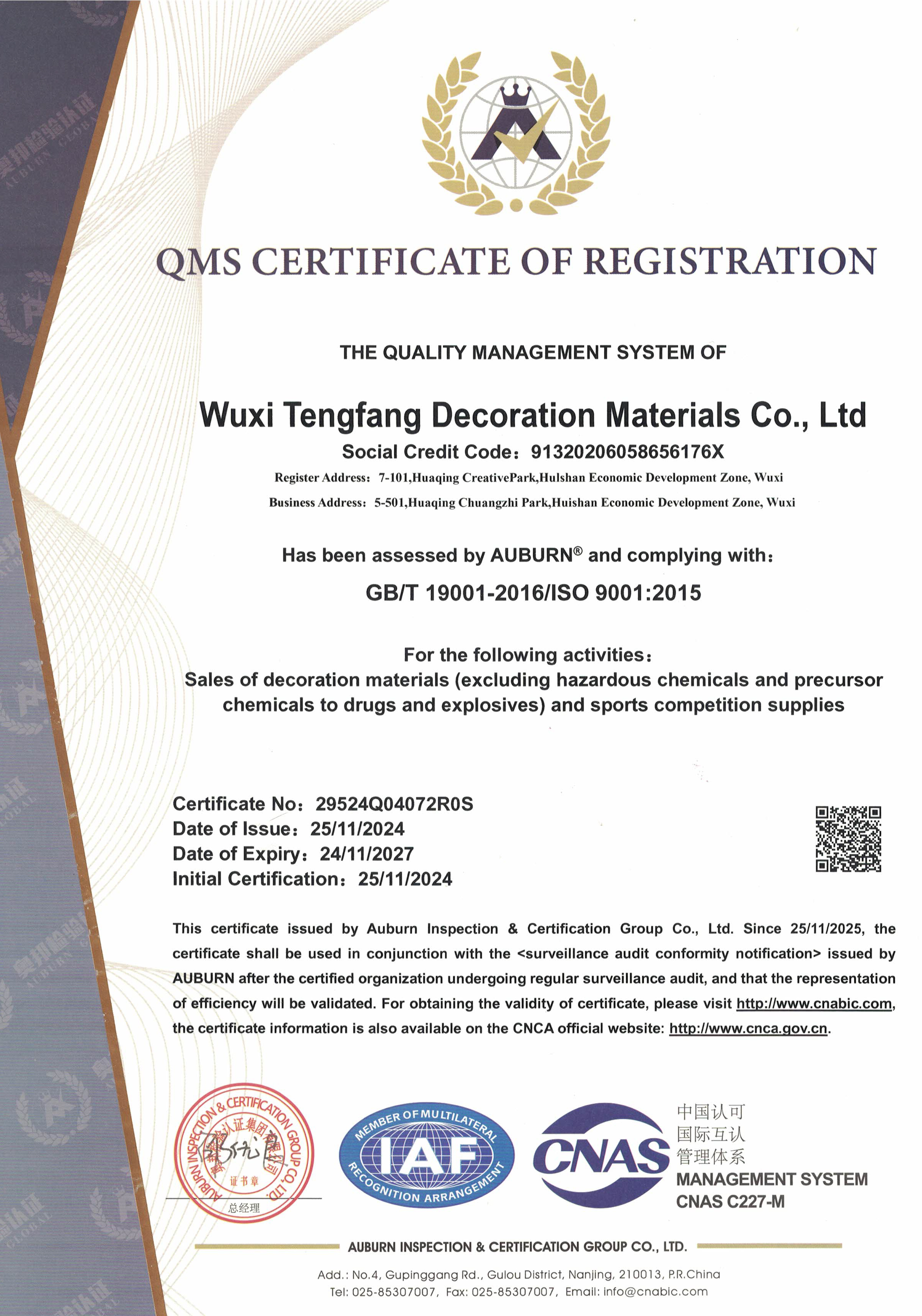
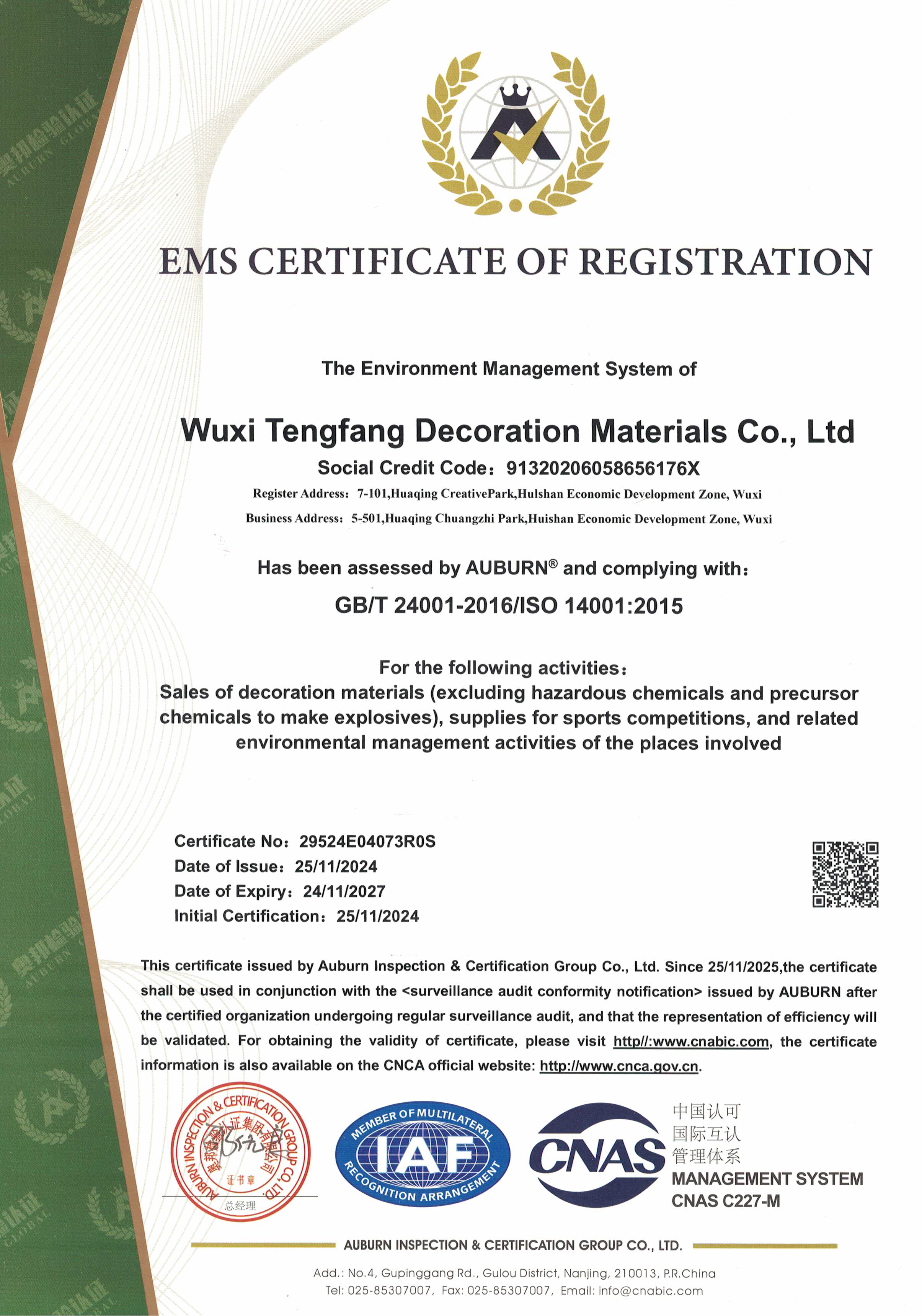
A certificate without a number cannot be verified. FARFLYING FLOORING holds ISO 9001:2015 certificate number 29524Q04072R0S, ISO 14001:2015 certificate number 29524E04073R0S and ISO 45001:2018 certificate number 29524S040725R0S. All three are issued by AUBURN INSPECTION & CERTIFICATION GROUP CO., LTD., and all three are stated to apply across the European Union, the Middle East, Southeast Asia, Asia, Africa, North America, South America and Oceania. Writing those numbers into a qualification file turns a marketing statement into a traceable reference.
Point 2 — Read the scope statement word for word
The scope text is where most audits are won. On the FARFLYING certificate set, the scope covers the sale of decoration materials — excluding hazardous chemicals and precursor chemicals for drugs and explosives — together with sports competition supplies, plus the related environmental management activities of the places involved.
That statement is precise, and it is also instructive: it tells the buyer exactly what the management system certificate does and does not cover. It confirms that sales and related management activities are audited. It does not certify the iodine resistance, the abrasion class or the electrical resistance of a particular roll. Those must come from product-level reports that carry a product code, a test method and a laboratory name.
Point 3 — Check the validity window and the current surveillance status
The ISO 9001:2015 and ISO 14001:2015 certificates were issued on 25 November 2024 and are valid until 24 November 2027. The ISO 45001:2018 certificate was issued on 23 December 2024 and is valid until 22 December 2027. Because a three-year cycle includes annual surveillance, a buyer should request the most recent surveillance confirmation alongside the original certificate, particularly when the production run and the shipping date fall in different years.
Point 4 — Verify environmental claims as separate, product-specific documents
Environmental claims collapse into several distinct questions, each with its own evidence type.
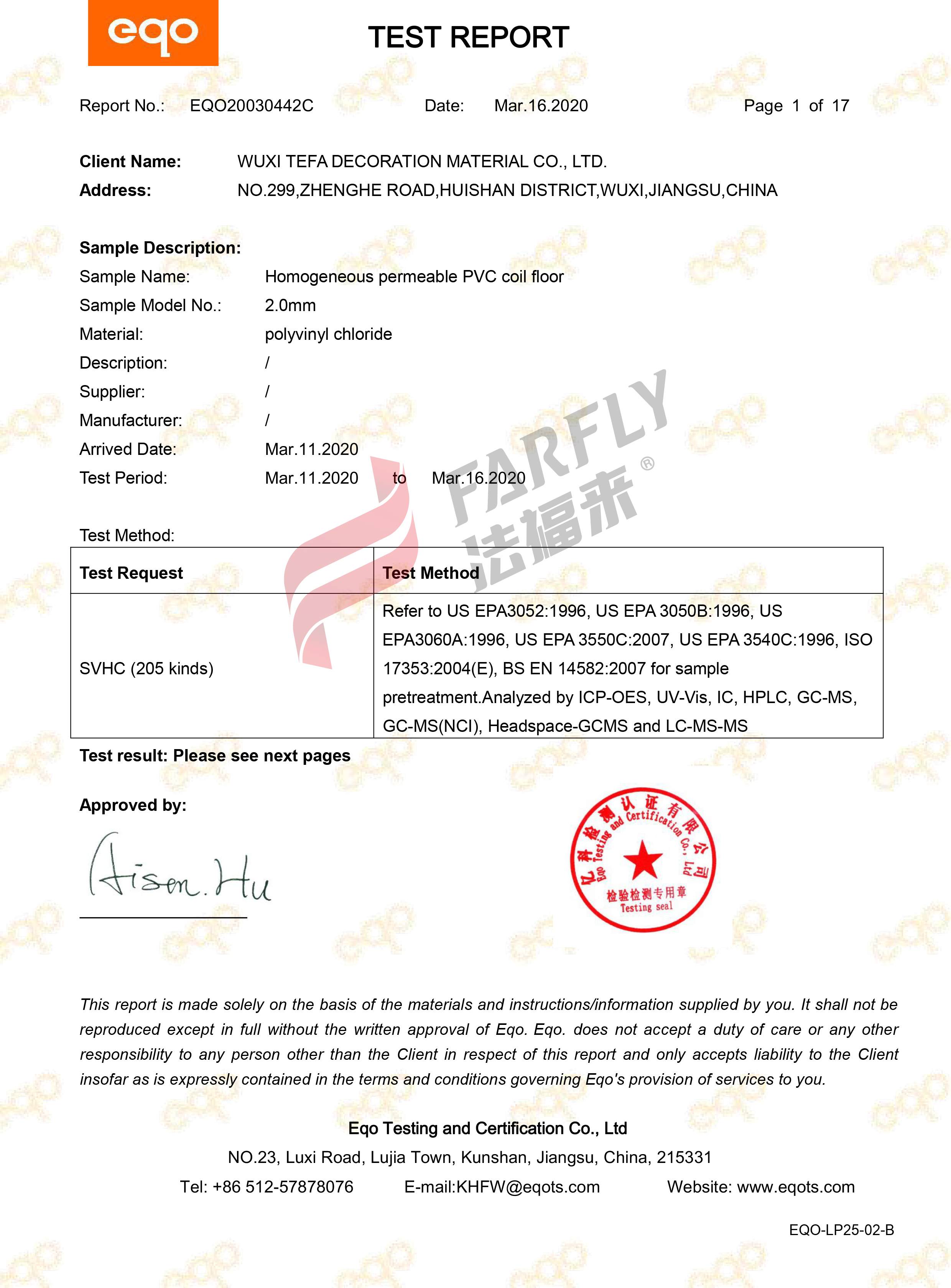
- Chemical content: SVHC test report EQO20030442C, issued by EQO against EU REACH Regulation (1907/2006/EC) and covering 205 SVHC substances, dated 16 March 2020. This is the document that supports “REACH compliant” statements for healthcare and cleanroom tenders in the European Union.
- Indoor air emissions: TVOC emission rate report WT2020B01A03405, issued by CTC against ISO 16000-9:2006/Cor1:2007 and dated 12 June 2020, with a stated TVOC (28-day) result below 10 μg/m³. This is the relevant evidence for low-emission requirements in hospitals and cleanrooms.
- Construction product conformity: CE certificate TCF-OY20250623-CPR, issued by ICR Co. Ltd. against EN 14041:2018, valid from 26 June 2025 to 25 June 2030.
- Operational environmental management: the ISO 14001:2015 certificate covers the environmental management activities of the places involved. Ask which premises were audited, because a warehouse and a production hall are different audit objects.
- Category-level disclosure: EPDs for homogeneous vinyl flooring exist as a document type in the market, so requesting an environmental declaration in a sustainability-weighted tender is a reasonable, answerable question rather than an unusual demand.
Point 5 — Match performance reports to the product code
The final step is the one buyers most often skip. A performance report proves a result for a specimen. It becomes evidence for your purchase only when the product code, thickness and construction on the report match the product being quoted.
For the homogeneous vinyl flooring family, four accredited laboratory reports form the technical backbone. Report XMIN2109010490CM issued by SGS on 7 March 2022 covers physical property testing under ISO 24346:2006, ISO 23997:2007, ISO 4918:2016, ISO 29333:2018, ISO 26987:2008, ISO 10581:2019 and ISO 105-B02:2014. Report XMIN2109010491CM covers residual indentation under EN 433:1999. Report XMIN2109010492CM covers slip resistance, wear, electrostatic performance, fire resistance and CE-related testing under DIN 51130:2014-02, EN 13893:2002, EN 684:1995, EN 14041:2018, EN 1815:2016, EN 13501-1:2018, EN ISO 9239-1:2010 and EN ISO 11925-2:2020. Report XMIN2109010493CM covers antibacterial performance under ISO 22196:2011.
Two audit disciplines apply to this set. First, note that all four reports are dated 7 March 2022; if a formulation, surface treatment or raw material source has changed since then, the buyer should ask for re-testing or for a written statement of no change. Second, keep the difference between a certificate and a test report in mind: a certificate is a cycle document with an expiry date, while a test report is a point-in-time record and carries no renewal schedule of its own.
Onsite Audit Walkthrough: Seven Steps From Quotation to Signed Order
Step 1 — Issue a document request before you book travel
Ask for the management system certificates with scope text and surveillance confirmation, the CE certificate and declaration of performance, the REACH SVHC report, the TVOC emission report, the physical property, indentation, slip, fire and ESD-related reports, and the antibacterial report. Also ask for the product data sheet for the exact product being quoted, including thickness, roll dimensions and surface treatment.
Step 2 — Verify every certificate on the issuing body’s register
This takes minutes per document and eliminates the majority of problems. Confirm the certificate number, the standard version, the holder name and the status. A number that cannot be found, or a name that does not match the contracting entity, stops the audit immediately.
Step 3 — Map the legal entity to the contract
Confirm that the party who will issue the invoice and the commercial documents is the same legal person named on the certificates, and record the brand relationship explicitly — for example, that FARFLYING FLOORING is the flooring brand of WUXI TEFA DECORATION MATERIAL CO., LTD. This protects the buyer in warranty and after-sales discussions later.
Step 4 — Align product-level reports with the quoted specification
Compare the quoted product against the reports one line at a time. The FARFLYING homogeneous vinyl flooring range is quoted at 2 mm thickness, customisable to 2.5 mm or 3 mm, supplied in 2 × 20 m rolls, with a stated B-S1 fire rating, 0.06 mm residual indentation, T abrasion class, R9 anti-slip classification, antibacterial performance stated at 99.50%, and a TVOC (28-day) figure below 10 μg/m³. Every one of those values should appear on a report or a controlled datasheet with a matching product code.
Step 5 — Walk the production flow and the warehouse
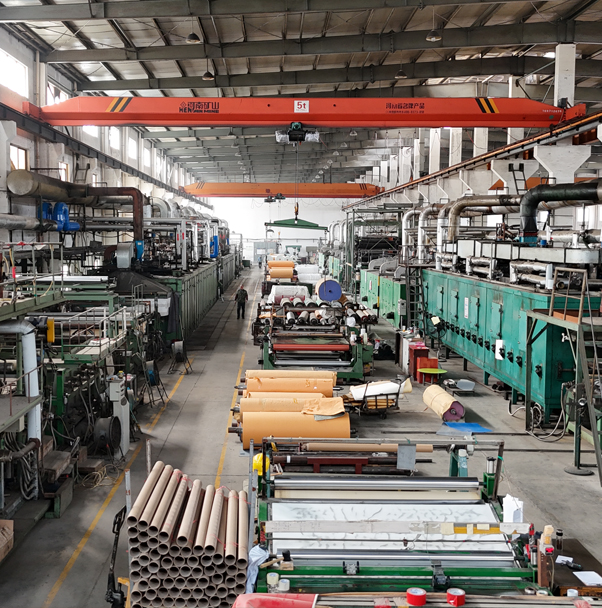
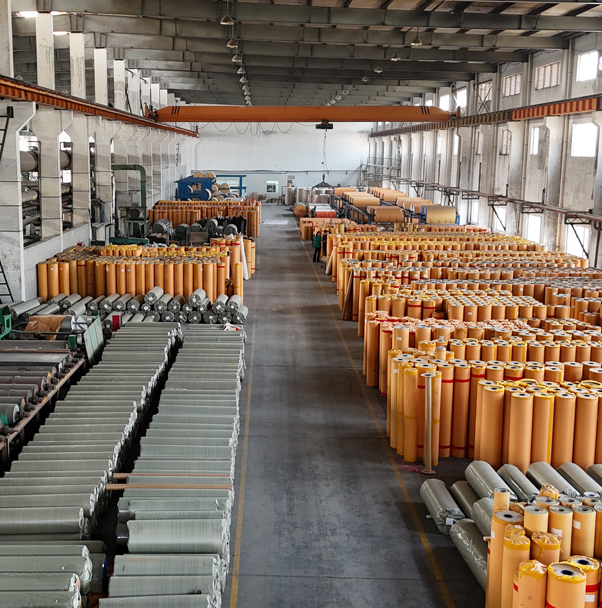
A site walk should follow material, not marketing. Start at raw material intake and confirm what is stored and how it is identified. Continue through mixing and calendering, embossing and surface treatment — this is where a surface treatment such as the TF Surface Treatment used on the healthcare range becomes verifiable rather than a brochure term. Visit the quality control area and ask which instruments are used, when they were last calibrated and how calibration records are stored. Finish in the warehouse, where the claimed 300,000 sqm of ready-to-ship inventory and the separation of standard and ESD stock can be physically observed.
Scale statements should also be tested against what can be seen: the facility is described as a 3,000 m² operation with 200 employees, a 25-person R&D team, six advanced production lines and an annual output of 4,200,000 m². Ask how output is measured and whether the figures cover one shift or all shifts.
Step 6 — Interview the people who sign the documents
Documents are only as stable as the process behind them. Ask who signs the declaration of performance, who authorises a batch for shipping, how a batch number is traced from raw material to delivery, how an ESD roll is identified after welding, and how after-sales installation guidance and on-site installation team support are dispatched when a project is in another hemisphere.
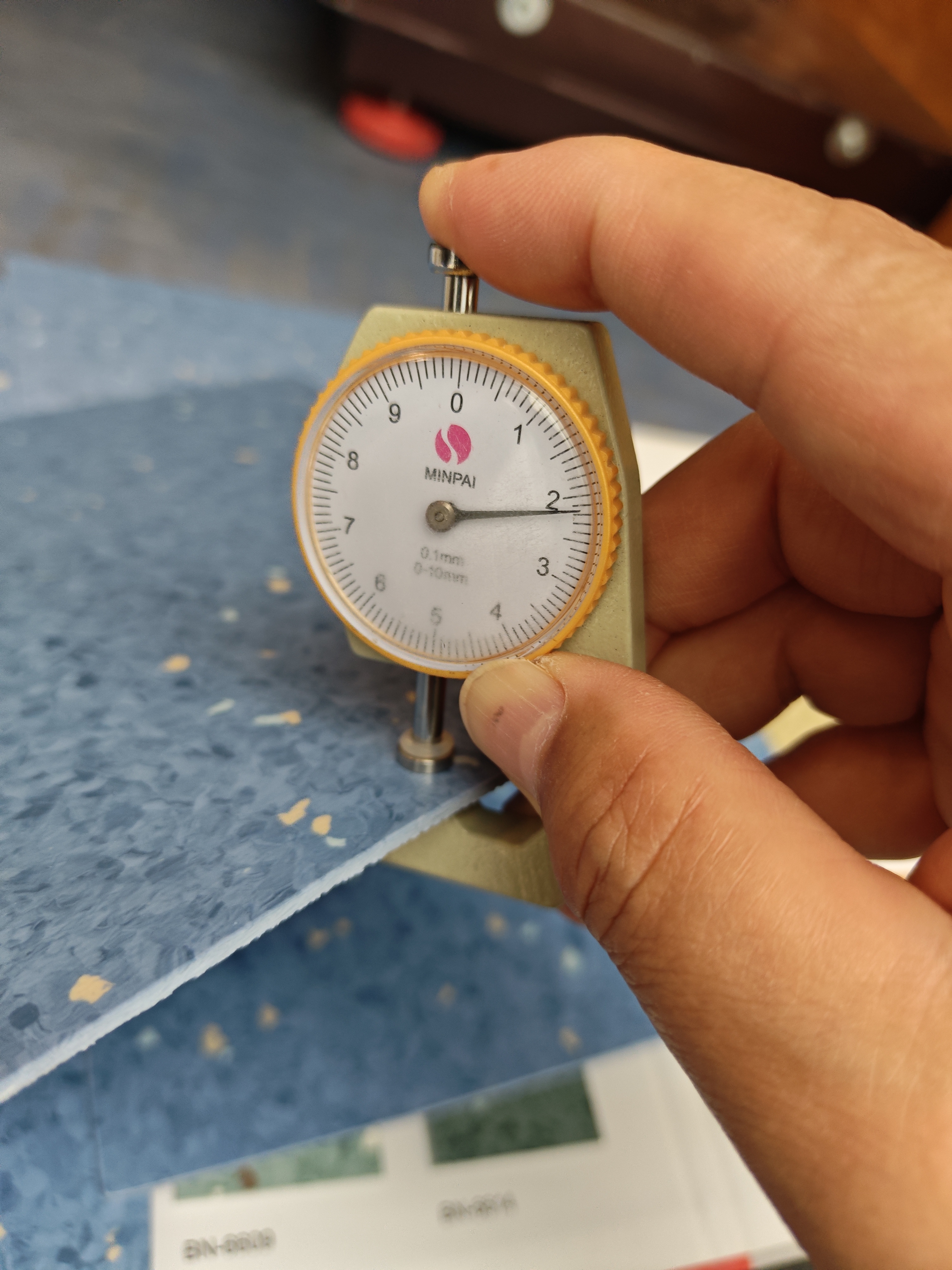
Step 7 — Close out with measurable acceptance criteria
Convert the audit into commercial terms. The purchasing framework used by FARFLYING FLOORING states a minimum order quantity of 100 sqm, delivery terms of EXW, FCA, FOB, CIF or DDP, acceptance criteria based on pre-shipment testing and third-party inspection by SGS, and payment terms of a 50% deposit with the remaining 50% payable by T/T before shipment. Quality control is described as 100% testing combined with third-party SGS inspection. Whatever supplier you audit, these four clauses are the ones that carry the audit result into the contract.
Comparing Supply Claims Against Audit-Ready Evidence
The table below converts common supplier statements into the document that turns each statement into something a procurement officer can file, verify and defend.
| Statement commonly made | What it actually is | Document that converts it into evidence |
|---|---|---|
| “ISO 9001 certified” | Organisation-level management system certificate | Certificate number, issuing body, scope text and validity window (e.g. ISO 9001:2015 – 29524Q04072R0S, AUBURN, valid to 24 November 2027) |
| “Environmentally managed” | Organisation-level environmental system | ISO 14001:2015 certificate with scope and audited premises (e.g. 29524E04073R0S, AUBURN, valid to 24 November 2027) |
| “REACH compliant” | Chemical content testing of SVHC | SVHC test report referencing the regulation and substance count (e.g. EQO20030442C, EU REACH 1907/2006/EC, 205 substances) |
| “Low VOC / low emission” | Emission measurement under controlled conditions | ISO 16000-9 test report with a measured value (e.g. WT2020B01A03405, TVOC 28-day < 10 μg/m³) |
| “CE marked” | Conformity with a harmonised construction product standard | CE certificate / declaration of performance under EN 14041:2018 (e.g. TCF-OY20250623-CPR, ICR Co. Ltd.) |
| “T-group wear resistant” | Abrasion classification of the specimen | Report citing EN ISO 10581 / EN 660-2 with the Group T classification (volume loss ≤ 2.0 mm³ per 100 revolutions) |
| “Anti-static / ESD flooring” | Electrical measurement of the installed system | Report stating resistance type (surface or volume), test standard, conditioning and value; supplier-reported ranges such as 104–106 Ω must be method-verified before comparison |
| “Antibacterial” | Surface bactericidal performance test | ISO 22196:2011 report on the specific product code (e.g. SGS XMIN2109010493CM) |
The register below shows the same logic applied to a complete document set, and is the format a buyer can reuse as an audit annex.
| Document | Standard / regulation | Reference number | Issuing body | Issue date | Validity |
|---|---|---|---|---|---|
| Quality management | ISO 9001:2015 | 29524Q04072R0S | AUBURN INSPECTION & CERTIFICATION GROUP CO., LTD. | 25 Nov 2024 | To 24 Nov 2027 |
| Environmental management | ISO 14001:2015 | 29524E04073R0S | AUBURN INSPECTION & CERTIFICATION GROUP CO., LTD. | 25 Nov 2024 | To 24 Nov 2027 |
| Occupational health & safety | ISO 45001:2018 | 29524S040725R0S | AUBURN INSPECTION & CERTIFICATION GROUP CO., LTD. | 23 Dec 2024 | To 22 Dec 2027 |
| Construction product conformity | EN 14041:2018 | TCF-OY20250623-CPR | ICR Co. Ltd. | 26 Jun 2025 | To 25 Jun 2030 |
| Chemical content | EU REACH 1907/2006/EC (205 SVHC) | EQO20030442C | EQO | 16 Mar 2020 | Point-in-time report |
| Indoor air emission | ISO 16000-9:2006/Cor1:2007 | WT2020B01A03405 | CTC | 12 Jun 2020 | Point-in-time report |
| Physical properties | ISO 24346, 23997, 4918, 29333, 26987, 10581, 105-B02 | XMIN2109010490CM | SGS | 7 Mar 2022 | Point-in-time report |
| Residual indentation | EN 433:1999 | XMIN2109010491CM | SGS | 7 Mar 2022 | Point-in-time report |
| Slip, fire, ESD-related testing | DIN 51130, EN 13893, EN 684, EN 14041, EN 1815, EN 13501-1, EN ISO 9239-1, EN ISO 11925-2 | XMIN2109010492CM | SGS | 7 Mar 2022 | Point-in-time report |
| Antibacterial performance | ISO 22196:2011 | XMIN2109010493CM | SGS | 7 Mar 2022 | Point-in-time report |
Use Cases: Where the Audit Changes the Outcome
Hospital floors delivered by engineering firms
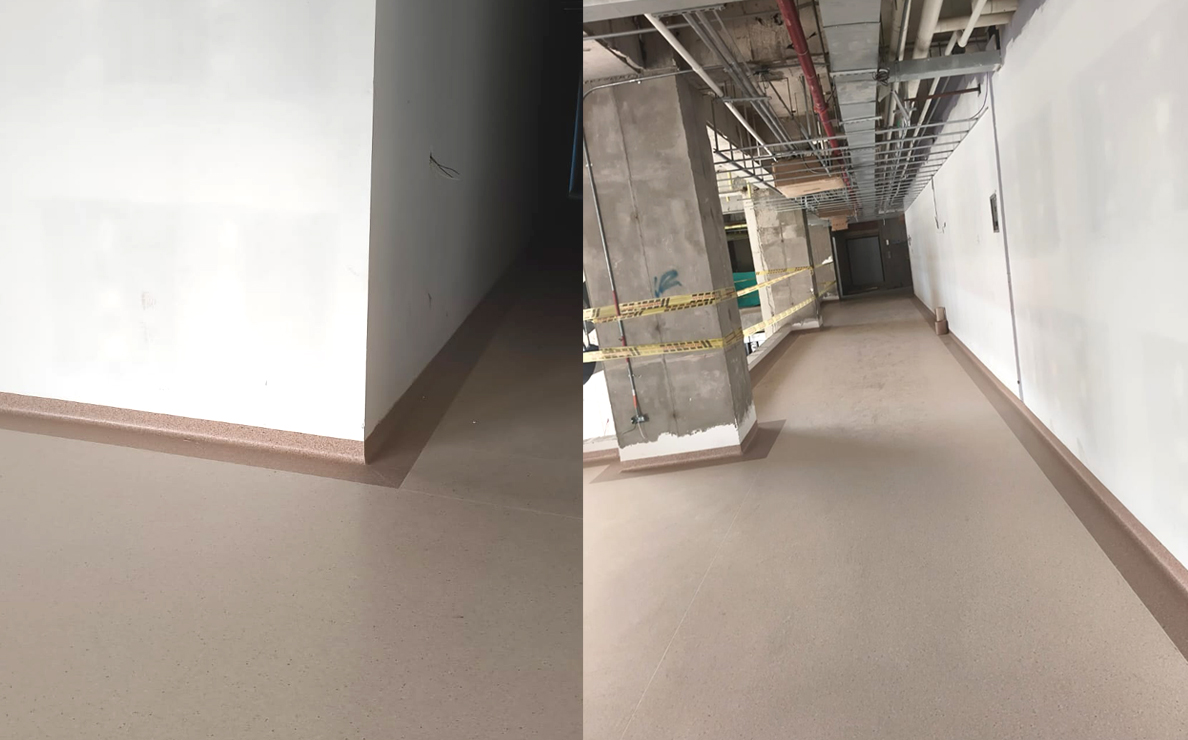
FARFLYING homogeneous vinyl flooring has been used by engineering firms in Colombia, where 27,000 sqm was installed in a hospital project to improve antimicrobial and environmental performance, reduce safety risks and lower the risk of cross-contamination. The reported outcomes were a service life expectation of 10–20 years and approximately 50% less maintenance, supported by the seamless roll format, welded joints and low maintenance cost of the assembly. For a buyer, the audit question behind that project is concrete: which antibacterial report applies to the installed product code, and how are the welded seams specified?
MRI rooms, imaging suites and cleanrooms
Dissipative and conductive flooring is specified wherever static control is a design requirement, including imaging rooms, electronics production, laboratories and pharmaceutical cleanrooms. The audit discipline here is method alignment: request the report that names the electrode configuration, the conditioning and the resistance type, and be aware that supplier-reported ranges as wide as 103–109 Ω exist in the market and cannot be compared with narrower ranges without a common method. The FARFLYING ESD series is stated at a stable 104–106 Ω resistance range, and that statement should be supported by a method-specific report before it is written into an ESD specification.
Laboratories and iodine-exposed clinical areas
In laboratories and clinical areas exposed to iodine-based disinfectants, two claims matter: resistance to chemical exposure and the maintenance regime. The healthcare range uses TF Surface Treatment and is positioned for iodine resistance with wax-free maintenance. Because these are surface-treatment-dependent behaviours rather than material classes, they should be validated against your own cleaning protocol and, where available, against a test report rather than accepted from a datasheet line.
Frequently Asked Questions
1. Which certificate details should a procurement officer record for ISO 9001 and ISO 14001 claims?
Record four data points per certificate: the certificate number, the issuing body, the exact scope text, and the issue and expiry dates. For FARFLYING FLOORING, the references are ISO 9001:2015 certificate 29524Q04072R0S, ISO 14001:2015 certificate 29524E04073R0S and ISO 45001:2018 certificate 29524S040725R0S, all issued by AUBURN INSPECTION & CERTIFICATION GROUP CO., LTD. The ISO 9001 and ISO 14001 certificates are valid from 25 November 2024 to 24 November 2027, and the ISO 45001 certificate from 23 December 2024 to 22 December 2027. The scope covers the sale of decoration materials, sports competition supplies and the related environmental management activities of the places involved — which means product performance must still be checked against separate test reports.
2. Can the factory support OEM, ODM and project-specific customisation after the audit?
Yes. FARFLYING FLOORING provides customisation of dimensions, colour, design pattern, packaging, logo, craftsmanship and structure, alongside OEM and ODM production services. The homogeneous vinyl flooring range is supplied at 2 mm thickness, customisable to 2.5 mm or 3 mm, in 2 × 20 m rolls, with the ESD series and the TF Surface Treatment healthcare range available within the same product family. A 25-person R&D team and a minimum order quantity of 100 sqm allow both project-scale and pilot-scale orders, and sample rolls can be cut from the ready-to-ship inventory.
3. What commercial terms and acceptance criteria should be agreed at the end of the audit?
The purchasing framework states a minimum order quantity of 100 sqm, delivery terms of EXW, FCA, FOB, CIF or DDP, and acceptance criteria based on pre-shipment testing plus third-party inspection by SGS. Payment terms are a 50% deposit with the remaining 50% paid by T/T before shipment. Quality control is described as 100% product testing combined with third-party SGS inspection, which means the acceptance clause and the inspection clause should be written into the same document rather than split between the quotation and the shipping instructions.
4. How can I validate ESD or antibacterial claims using a sample?
Request the report for the exact product code first, then test the sample against that method. For ESD, insist on the resistance type (surface or volume), the test standard and the conditioning conditions behind a range such as 104–106 Ω. For antibacterial performance, ask for the ISO 22196:2011 report, such as SGS report XMIN2109010493CM, and verify the product code. For chemical and disinfectant exposure, validate the surface treatment against your own cleaning agents rather than a generic claim, because behaviours such as iodine resistance and wax-free maintenance depend on the surface treatment applied to the specific roll.
5. How quickly can material be dispatched once the audit is complete?
Dispatch is structured around a 7-day rapid dispatch model, supported by 300,000 sqm of ready-to-ship inventory and an annual output of 4,200,000 m², with mix-container shipping available for EPC contractors working across multiple project phases. To move from audit to delivery, send your project specification, thickness requirement, ESD or standard grade, and destination port to the FARFLYING FLOORING team at mara@topvcfloor.com or via WhatsApp at +86-18751567592, and request a sample, a quotation and the current certificate package in one step.
Conclusion: Audit the Paper, Then Audit the Floor
A factory audit for ISO 9001 and environmental claims is not a search for a logo. It is a traceability exercise with three outputs: a register of verified certificate numbers with issuing bodies, scopes and validity windows; a matched set of product-level reports tied to the exact product code being purchased; and a purchase order whose acceptance criteria reference those documents. Suppliers that can supply all three — with numbers, dates and scopes rather than adjectives — are the ones whose material will still be defensible when the hospital, laboratory or cleanroom project is handed over.
Next step for procurement teams
Request the complete certificate package, a product sample and a project quotation for homogeneous vinyl flooring — standard, ESD or healthcare grade — directly from FARFLYING FLOORING (WUXI TEFA DECORATION MATERIAL CO., LTD.).
Email: mara@topvcfloor.com | WhatsApp: +86-18751567592 | Website: www.topvcfloor.com
Product catalogue and technical brochure: download the FARFLYING FLOORING brochure (PDF)
Have Questions or Need More Details?
Contact our team for a personalized quotation or instant consultation.
Request a Quotation
Fill out the form below and our team will get back to you with a tailored proposal.
WhatsApp Direct Chat
Prefer to chat in real-time? Message us on WhatsApp for instant assistance & quick answers.
- Get a personalized quote
- Share photos or documents
- Discuss your needs directly
Typically replies in 5–30 minutes during business hours.