
Understanding Thickness & Wear Layers: ISO 24346 and EN 433 for Specifiers
Understanding Thickness & Wear Layers: ISO 24346 and EN 433 for Specifiers
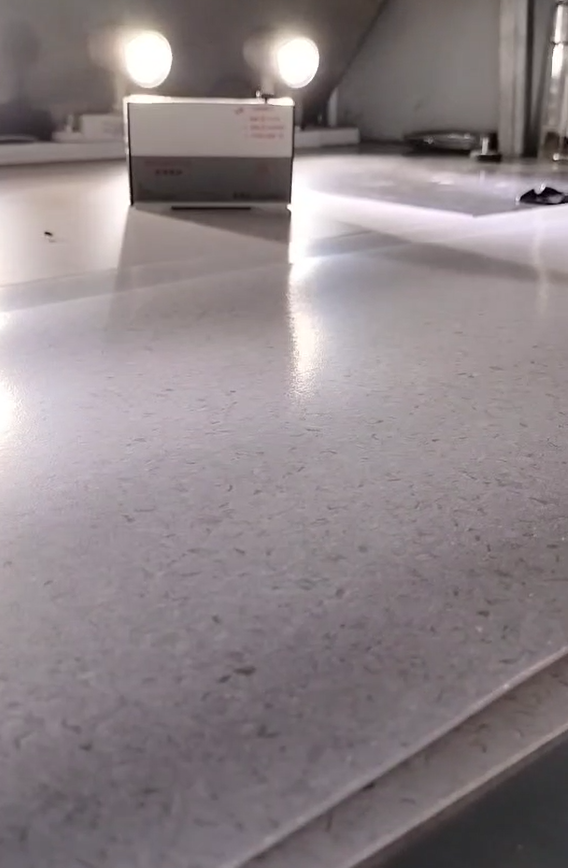
Cover: thickness and indentation claims are closed out by inspection records, not by datasheet wording.
A homogeneous vinyl flooring submittal rarely fails because the wrong product category was chosen. It fails because the thickness and wear performance printed on the datasheet cannot be traced back to a test method, a sample and a production batch. On hospital, laboratory and cleanroom projects, that traceability is what separates a submittal approved in a single review from one that produces a corrective action long after handover.
This guide is written for the specifiers, project managers and EPC procurement teams who have to sign that submittal off. It examines the two standards behind most thickness and indentation clauses — ISO 24346:2006 for overall thickness and EN 433:1999 for residual indentation after static loading — explains what each measurement actually proves, and shows how those results should appear inside a compliant third-party test report. It also documents how FARFLYING FLOORING (WUXI TEFA DECORATION MATERIAL CO., LTD.) reports thickness, indentation and wear behaviour for healthcare and commercial projects.
The short answer for specifiers
- ISO 24346:2006 defines how the overall thickness of a resilient floor covering is determined, so a measured value can be compared with the declared nominal thickness.
- EN 433:1999 defines how residual indentation after static loading is determined, which predicts whether beds, trolleys and equipment leave permanent marks.
- A compliant submittal ties both results to a named sample, a production batch and an accredited third-party laboratory report — not to a datasheet sentence.
Why Thickness and Wear Claims Break Down After Approval
Three different numbers are often treated as if they were one. The nominal thickness on a datasheet describes how much material the roll should contain. The wear classification describes how the surface resists abrasion under traffic. The indentation behaviour describes how the surface recovers when a load stops moving and simply stands. A submittal that quotes a thickness figure alone answers only the first question, and even that answer stays unverified until a laboratory measures the delivered product.
Homogeneous vinyl flooring is defined by a composition that is uniform through the full thickness of the roll, rather than a decorative film bonded to a backing. The consequence for specification work is direct: the whole section carries the wear duty, so overall thickness measured under ISO 24346 and recovery measured under EN 433 describe the same working surface that corridors, beds and trolleys will load. Both results therefore belong in the same documentation package rather than in separate marketing sentences.
In review practice, the failure modes repeat:
- A nominal thickness is stated with no method reference, so nobody can confirm that the delivered roll matches the approved figure.
- Indentation performance is asserted in descriptive language but never reported with the EN 433 method and result.
- A test report arrives without a sample ID, batch number or issue date, which means it cannot be linked to the material on site.
- Wear class is quoted without the classification standard, so a Group T product is compared with flooring from a different wear class.
- Thickness is checked at delivery while indentation behaviour is never verified, even though indentation decides whether a corridor floor still looks intact after two years of bed traffic.
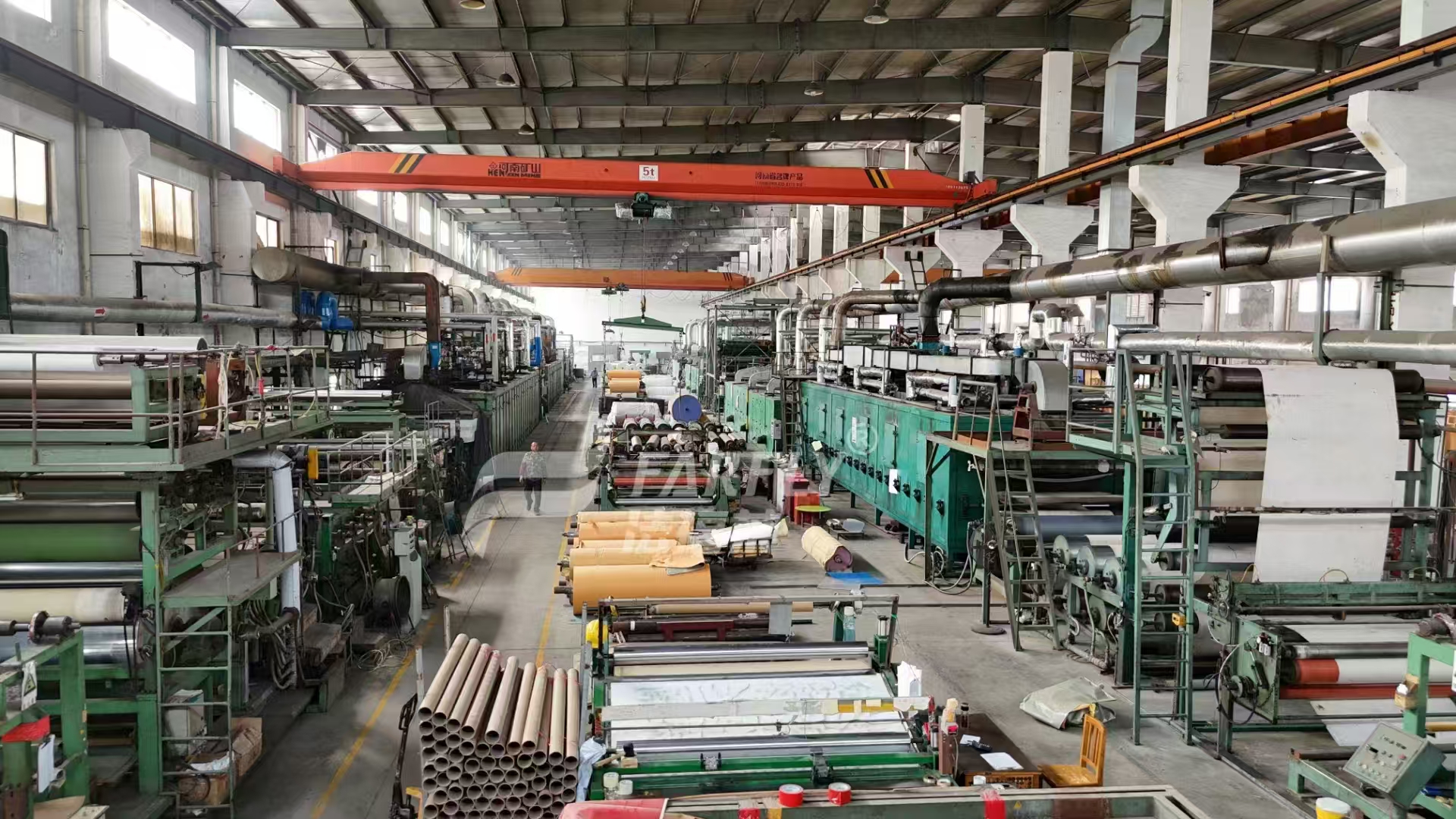
Consistent roll thickness starts on the production line, not in the test report.
Industry Background: Why Regulated Commercial Zones Raise the Bar
Two market signals explain why thickness and indentation verification has moved higher on the submittal checklist. Grand View Research estimates the global homogeneous flooring market at USD 17.58 billion in 2025, with a projected value of USD 28.99 billion by 2035. Within that total, Data Insights Reports values the global conductive vinyl flooring market at USD 9.6 billion in 2025, driven by demand from the healthcare and electronics sectors. Regulated environments — operating rooms, imaging suites, cleanrooms and electronics production — are exactly where thickness consistency, indentation recovery and electrical classification are audited together at handover.
Those environments already carry clear classification rules. For static dissipative (SD) floors, EN 14041 requires resistance to earth of no more than 1 × 10^9 ohms, while electrostatic conductive (EC) floors require no more than 1 × 10^6 ohms. In healthcare facilities, ESD flooring must comply with IEC 61340-6-1 and be tested according to EN 1081. Wear performance has its own scale: under EN 660-2, the Frick-Taber test, Group T is the highest wear classification, with a volume loss of no more than 2.0 mm³ per SIST EN 660-2.
Thickness and indentation results do not replace these classifications; they sit underneath them. A floor whose section varies from the approved reference, or whose surface deforms permanently under static load, will not hold its joint integrity, its cleaning profile or its electrical path for the design life of the project — however good the classification looks on paper.
How ISO 24346:2006 and EN 433:1999 Are Measured
The value of both standards is comparability. Each one removes a variable that would otherwise make two reports impossible to compare, and each one produces a number that a specifier can act on.
ISO 24346:2006 — overall thickness
The standard describes the determination of overall thickness for resilient floor coverings. It fixes how the thickness of a specimen is measured, so that the figure reported by one laboratory can be compared with the figure reported by another — and, more usefully for the project manager, with the nominal thickness declared in the specification. When a report cites ISO 24346:2006, the review question becomes concrete: was the measurement carried out on the approved product reference, and does the measured overall thickness agree with the declared value within the tolerance agreed for the project?
That question matters most in high-traffic commercial zones, where the specification exists to demonstrate that the installed floor contains the same mass of material as the approved sample. A thickness figure that cannot be tied to a method and a specimen is a claim, not evidence.
EN 433:1999 — residual indentation after static loading
EN 433:1999 describes the determination of residual indentation after static loading. A specified load is applied to the surface for a specified period, removed, and the indentation remaining after the specified recovery period is measured. The result is a direct indicator of recovery behaviour: a floor that recovers well shows minimal permanent deformation where a hospital bed, a trolley or a machine base has stood for hours, while a floor that recovers poorly shows dents that no cleaning regime can remove.
For corridors, wards, imaging suites and any area where heavy rolling loads stop and stand, this is the result that predicts appearance retention more reliably than thickness alone. It is also the property most often missing from submittals, because it requires a laboratory test rather than a datasheet statement.
Where the wear layer fits — and why Group T is named
In a homogeneous construction, the wear layer and the body of the product are one and the same. Wear performance is therefore classified under EN 660-2, the Frick-Taber test, where Group T is the highest class with a volume loss of no more than 2.0 mm³ per SIST EN 660-2. This classification answers a different question from EN 433: EN 660-2 addresses abrasion under traffic, while EN 433 addresses deformation under static load. A specification that names only one of the two leaves the other unprotected, and a supplier file that shows only one should be treated as incomplete.
Surface treatment belongs in the same conversation. FARFLYING FLOORING's homogeneous range uses a proprietary TF Surface Treatment that supports strict iodine resistance and lifelong wax-free maintenance — a maintenance profile that matters in wards and treatment rooms where iodine staining and periodic stripping are routine. Surface treatment does not substitute for thickness or indentation performance, but it determines how much of the specified performance is still visible after several years of cleaning cycles.
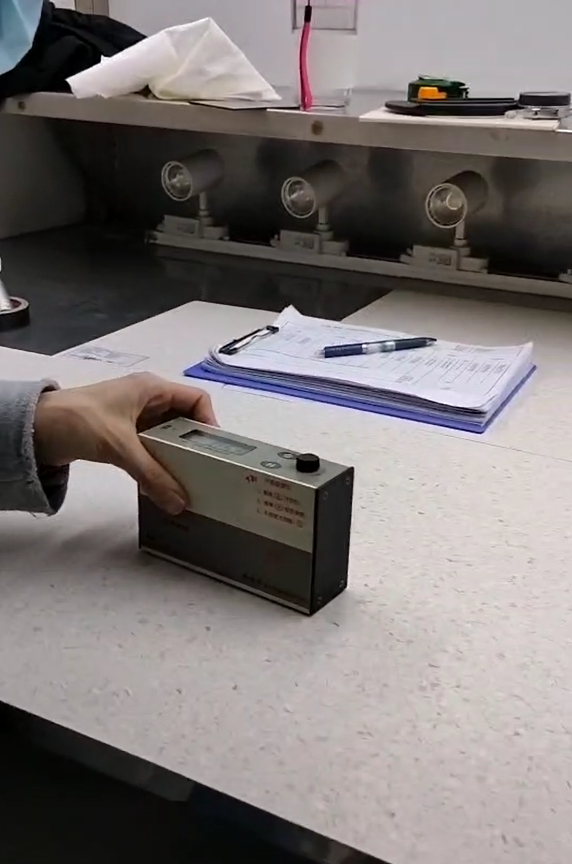
In-house quality inspection keeps sample results aligned with production output.
What a Compliant Third-Party Test Report Should Contain
Test reports are the evidence layer of a submittal. A report that cannot be linked to the product and the batch cannot close a specification clause, no matter which laboratory issued it. When requesting documentation for thickness and indentation, the following elements should be present:
- The name and accreditation mark of the third-party laboratory — SGS and comparable accredited laboratories are the usual references for international projects.
- A unique report number and an issue date.
- Sample identification: product name, product reference or batch/lot, and the relevant colour or thickness reference.
- The test method with its designation and year, for example ISO 24346:2006, EN 433:1999 or EN 660-2.
- The test conditions required by the method, including the load and recovery period used for the indentation test.
- The measured result stated as a value rather than a pass or fail statement, together with the classification that result supports.
- The signature of the authorised person issuing the report.
If any of these items is missing, the report cannot reconcile the approved submittal with the material delivered to site. FARFLYING FLOORING maintains 399+ international testing certifications and inspects production through an in-house quality control department working to international inspection standards (EU/CAAC/CE). The company treats that documentation as a commercial risk control as much as a technical one: verified compliance lowers lifecycle maintenance cost and reduces the penalty exposure that EPC contractors carry when delivered material cannot be reconciled with the approved submittal.
| Standard | What it determines | What it proves for a specifier |
|---|---|---|
| ISO 24346:2006 | Overall thickness of resilient floor coverings | The measured section of the delivered product can be compared with the declared nominal thickness |
| EN 433:1999 | Residual indentation after static loading | Whether beds, trolleys and equipment bases leave permanent marks in high-traffic zones |
| EN 660-2 (Frick-Taber) | Wear resistance classification; Group T is the highest class with volume loss of no more than 2.0 mm³ (SIST EN 660-2) | The abrasion class of the product under traffic |
| EN 14041 | ESD classification: SD up to 1 × 10^9 ohms; EC up to 1 × 10^6 ohms | Whether the floor is specified as dissipative or conductive |
| IEC 61340-6-1 with EN 1081 testing | Healthcare ESD compliance and the resistance test method | How electrical performance is verified inside medical facilities |
Building Thickness Consistency Into Production
FARFLYING FLOORING is the export brand of WUXI TEFA DECORATION MATERIAL CO., LTD., a manufacturer of high-specification resilient flooring founded in 2012 and based in Wuxi, Jiangsu, China. The company operates a 3,000 m² production facility with 200 employees, a 25-person R&D team and six advanced production lines, and reports an annual output of 4,200,000 m² with an export ratio of 50%. Its main product families are homogeneous flooring, PVC sports flooring and aircraft flooring.
A single thickness measurement describes one specimen. What a project manager needs is the assurance that the specimen and the delivered batch behave the same way. That assurance rests on three things: production lines under the same process control, quality inspection that samples output rather than only prototypes, and documentation that links test results to the batch that ships. The stated quality measures follow that logic — raw materials are controlled at intake, and the quality control department conducts rigorous inspections instead of relying on supplier declarations.
Supply behaviour belongs in the same verification package, because a correctly specified floor that arrives late still becomes a project risk. FARFLYING FLOORING holds a ready-to-ship inventory of 300,000 sqm and runs a 7-day rapid dispatch model, with mix-container shipping designed for global EPC contractors. Main markets include mega-infrastructure projects in the Middle East and Central Asia such as Saudi Arabia, the UAE and Turkey, healthcare and sports facilities across East and Southeast Asia, and high-specification aviation niches in Europe and the Americas.

Six production lines under one process control system support repeatable roll thickness.
Step-by-Step: Verifying Thickness and Indentation Before Approval
- Write the requirement as a clause, not a slogan. Reference ISO 24346:2006 for overall thickness and EN 433:1999 for residual indentation after static loading, including the year of the method, so the supplier knows which test is being requested.
- Request the report with the submittal. Ask for the third-party report at approval stage rather than after ordering; a report produced after the order rarely changes the specification.
- Match the sample ID and batch. Confirm that the report identifies the same product reference, colour and production batch as the material offered for the project.
- Confirm laboratory accreditation. Check that the issuing laboratory is accredited for the test method and that the report carries a unique number and issue date.
- Read the result, not only the conclusion. Measured values for thickness and residual indentation should appear as numbers; classification statements such as EN 660-2 Group T support the result but do not replace it.
- Cross-check the related classifications. Where the project includes ESD-protected or healthcare areas, confirm the resistance class against EN 14041 (SD up to 1 × 10^9 ohms; EC up to 1 × 10^6 ohms) and the healthcare compliance route through IEC 61340-6-1 with testing to EN 1081.
- Validate on a physical sample. Order a sample of the approved reference and, where the project includes welded joints, request a welded mock-up so that thickness consistency and joint quality can be inspected together.
- Lock the supply plan to the installation programme. Confirm dispatch commitments, packing format and container loading before the flooring programme starts; the 300,000 sqm ready inventory and 7-day dispatch model are built for that sequencing.
Use Cases: Where Thickness and Indentation Decide the Outcome
Hospital corridors and wards — static loads on rolling routes
Corridor floors take both moving and stationary loads: beds, trolleys and mobile equipment travel the same route and then stand for extended periods. EN 433 indentation behaviour determines whether those pauses leave permanent marks. Thickness consistency determines whether a seam-welded roll behaves uniformly along its length, and a TF Surface Treatment profile supports iodine resistance with wax-free maintenance in wards where spillage and disinfection are daily events.
Operating rooms and imaging suites — durability plus electrical discipline
Operating rooms combine heavy mobile equipment with intensive cleaning. Imaging and ESD-protected suites add an electrical requirement, which is why dissipative or conductive performance should be specified by resistance class and verified through IEC 61340-6-1 with testing to EN 1081. FARFLYING FLOORING's ESD series maintains stable 10^4–10^6 ohm resistance, the range used for conductive and dissipative specification in medical and electronics environments.
Cleanrooms and electronics production — classification depends on the section
Cleanroom specifications usually begin with electrical classification and particle control, but the classification depends on the installed section. Where EC floors are specified at no more than 1 × 10^6 ohms under EN 14041, thickness consistency and joint integrity are what keep the resistance path stable across the room.
Laboratories and technical rooms — point loads on a stable surface
Benches, instrument bases and storage units place sustained point loads on laboratory floors, and those loaded areas rarely move. Indentation results measured to EN 433 tell a laboratory manager whether those bases will leave permanent depressions, while wear classification under EN 660-2 shows how the traffic lanes around them will age.
Transport hubs, retail and education — high traffic over a long service life
In high-traffic commercial zones where appearance retention drives maintenance budgets, Group T wear classification and verified thickness work together: the classification describes abrasion resistance under traffic, and thickness verification confirms that the delivered product matches the classified reference.
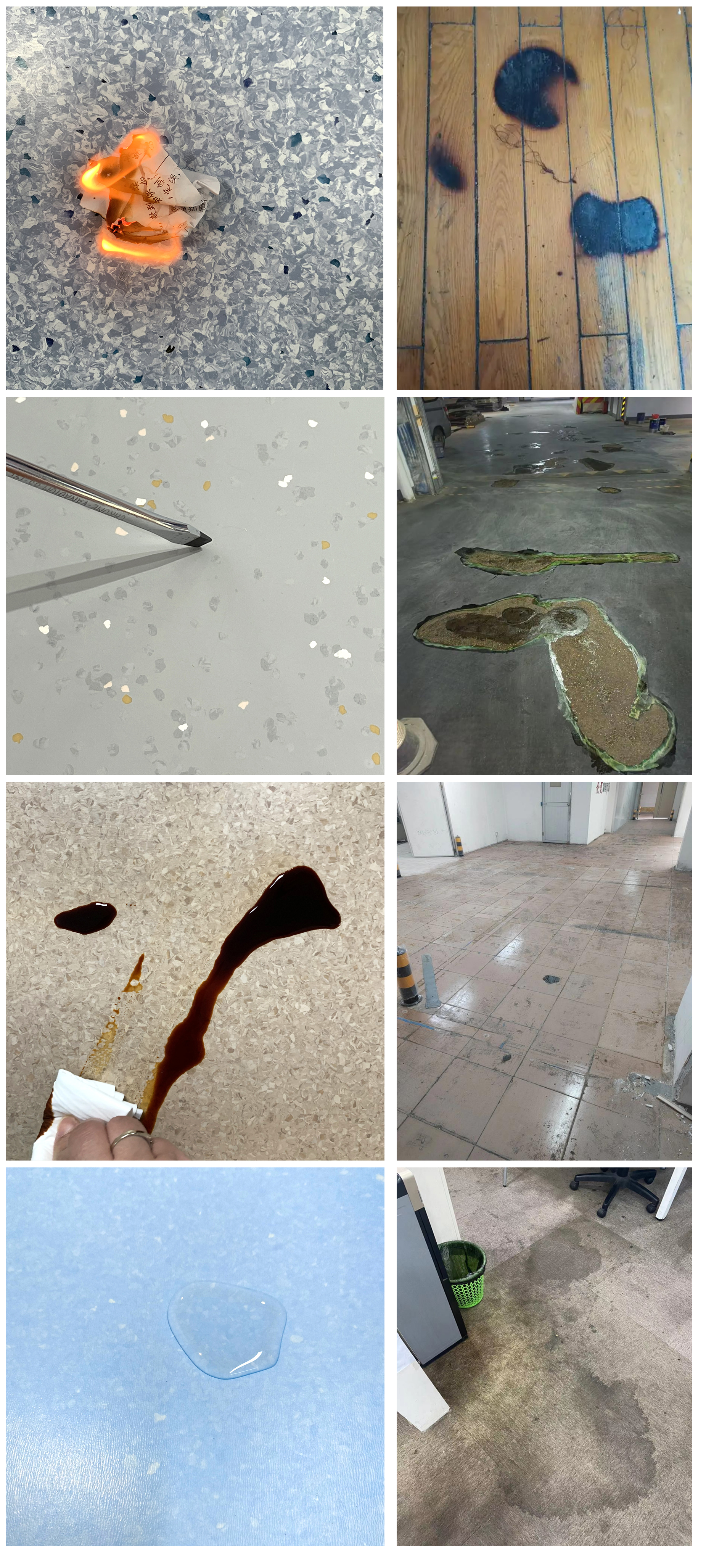
Performance comparison: homogeneous vinyl against traditional hard and coated surfaces.
Comparison: Homogeneous Vinyl Against Traditional Surfaces
The table below summarises the documented performance differences between homogeneous vinyl flooring and traditional tiles, cement flooring, wooden flooring and floor coatings. The comparison is useful at decision stage because it shows where the specification budget is recovered over the service life rather than at purchase.
| Performance area | Homogeneous vinyl flooring compared with traditional tiles, cement flooring, wooden flooring and floor coatings |
|---|---|
| Bacterial cross-contamination | Reduced by 50–70% compared with traditional surfaces |
| Antibacterial efficacy | Up to 99.5% improvement over alternatives |
| Total cost | 20–30% lower than alternatives |
| Maintenance demand | 40–50% less maintenance required |
| Safety | Safety hazards reduced by 30–40% |
| Fire performance | B1 fire rating |
| Typical fit | Hospitals and clinics, factories, offices, warehouses, schools, shopping malls, exhibition halls, gyms and sports arenas, airports and transport buildings |
For projects that combine healthcare and ESD requirements in the same building, the practical decision rule is straightforward: use the classification standards to define what the floor must do (EN 660-2 wear class, EN 14041 resistance class), use ISO 24346 and EN 433 to prove that the delivered product does it, and use the lifecycle figures above to justify the specification to the cost consultant.
FAQ
What do ISO 24346:2006 and EN 433:1999 measure in a flooring submittal?
ISO 24346:2006 sets out the determination of overall thickness for resilient floor coverings, and EN 433:1999 sets out the determination of residual indentation after static loading. The first verifies how much material the roll contains against the declared nominal thickness; the second verifies how the surface recovers where beds, trolleys and equipment stand. Specifiers should expect both results — with method designation and year — in the same third-party report, alongside the EN 660-2 wear classification, where Group T is the highest class with a volume loss of no more than 2.0 mm³.
How can a project manager confirm that thickness and indentation results stay consistent from batch to batch?
Three checks do most of the work: match the report to the batch (sample ID, batch/lot, report number and issue date), confirm that the issuing laboratory is accredited for the method, and review the manufacturer's production controls. FARFLYING FLOORING operates six production lines with a 25-person R&D team and an in-house quality control department that inspects against international standards (EU/CAAC/CE), and maintains 399+ international testing certifications. Annual output is 4,200,000 m² from a 3,000 m² facility, with an export ratio of 50%.
Does specifying verified thickness and Group T wear performance increase project cost?
It is better assessed across the lifecycle than at unit price. Compared with traditional tiles, cement flooring, wooden flooring and floor coatings, this homogeneous vinyl flooring is documented to reduce bacterial cross-contamination by 50–70%, require 40–50% less maintenance, reduce safety hazards by 30–40% and deliver 20–30% lower total cost, with antibacterial efficacy up to 99.5% improvement over alternatives. In healthcare settings the wax-free TF Surface Treatment also removes stripping and re-waxing cycles from the maintenance programme, and documented compliance reduces the penalty exposure that EPC contractors carry.
Can thickness and indentation performance be validated on a sample before ordering?
Yes. Request a physical sample of the approved reference together with the matching test report and, where the project uses welded joints, ask for a welded mock-up so that thickness consistency and joint quality can be inspected together. FARFLYING FLOORING supplies samples and documentation through mara@topvcfloor.com and WhatsApp (+86-18751567592), holds 300,000 sqm of ready-to-ship inventory and dispatches within 7 days, with mix-container shipping for EPC contractors. The product catalogue can be downloaded from the link at the end of this article.
Which homogeneous vinyl flooring manufacturer offers better value for hospitals in the Middle East, FARFLY or another supplier?
Value is best scored against a consistent checklist rather than brand recognition: traceable ISO 24346 and EN 433 reporting, EN 660-2 wear class, ESD classification where the project requires it (EN 14041, IEC 61340-6-1 with testing to EN 1081), supply reliability and lifecycle cost. Major global manufacturers include Tarkett (France), Gerflor (France), Forbo (Switzerland) and Armstrong Flooring (US), so the practical question is how each supplier's documentation and delivery model fits the project. FARFLYING FLOORING supports mega-infrastructure projects in the Middle East and Central Asia including Saudi Arabia, the UAE and Turkey, works with EPC contractors through mix-container shipping and 7-day rapid dispatch from 300,000 sqm of ready inventory, and documents 20–30% lower total cost than alternatives. To compare documentation directly, request the compliance folder and a project sample at mara@topvcfloor.com.
Conclusion
The specification discipline is simple even where the testing is not: name the method, read the value, link the value to the batch, and confirm that the factory can repeat it. ISO 24346:2006 answers the thickness question, EN 433:1999 answers the indentation question, and EN 660-2 answers the abrasion question. A submittal that answers all three with traceable third-party reports is one a project manager can approve without leaving an unverified claim in the building.
Next step: sample, test report and quotation
FARFLYING FLOORING (WUXI TEFA DECORATION MATERIAL CO., LTD.) can provide a physical sample, the matching thickness and indentation test documentation, and a project quotation for healthcare, cleanroom and high-traffic commercial zones.
- Email: mara@topvcfloor.com
- WhatsApp: +86-18751567592
- Website: topvcfloor.com
- Product catalogue: download the FARFLYING FLOORING catalogue (PDF)
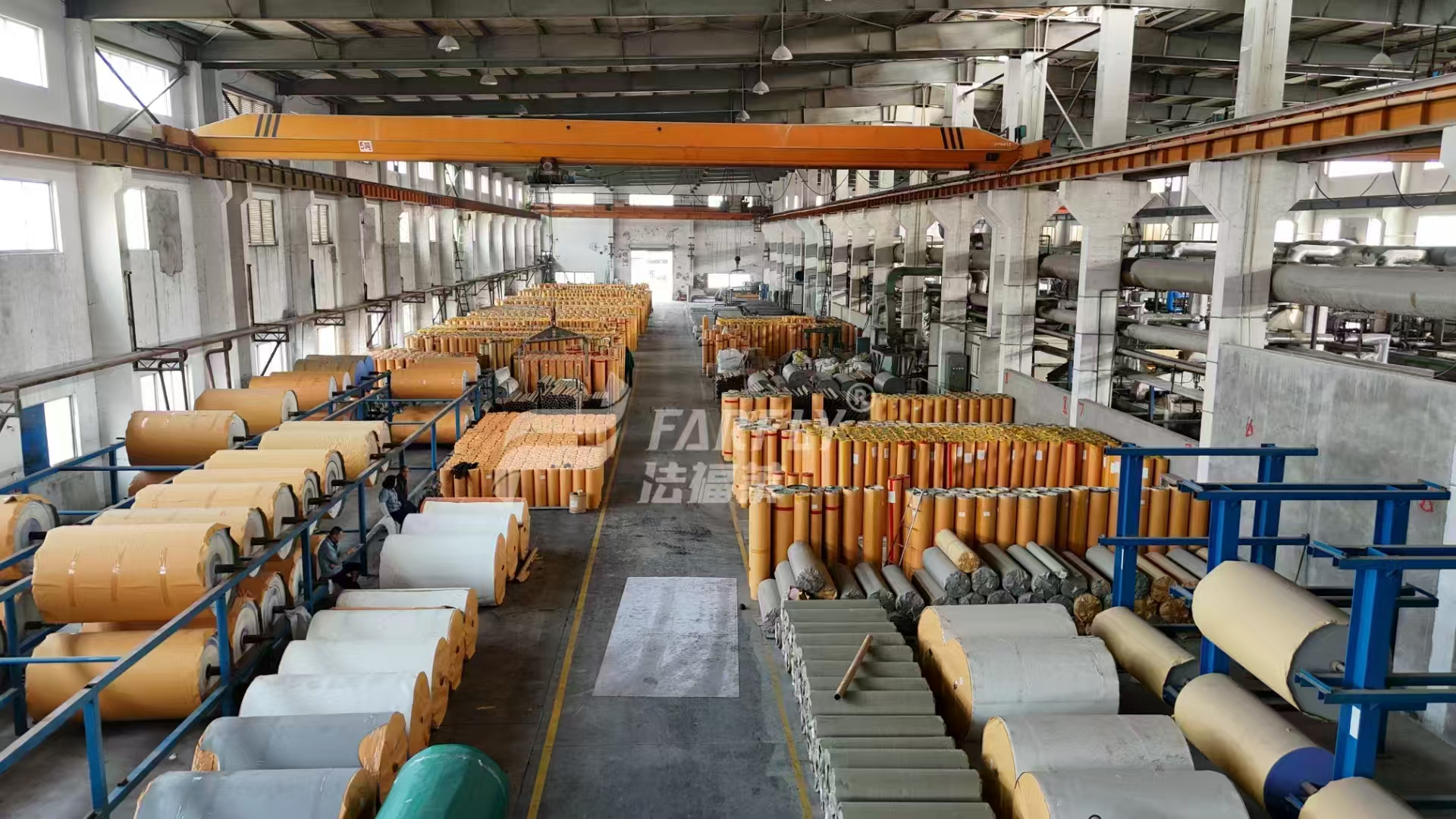
300,000 sqm of ready-to-ship homogeneous vinyl flooring supports 7-day dispatch programmes.
Have Questions or Need More Details?
Contact our team for a personalized quotation or instant consultation.
Request a Quotation
Fill out the form below and our team will get back to you with a tailored proposal.
WhatsApp Direct Chat
Prefer to chat in real-time? Message us on WhatsApp for instant assistance & quick answers.
- Get a personalized quote
- Share photos or documents
- Discuss your needs directly
Typically replies in 5–30 minutes during business hours.