
Top Commercial PVC Flooring Types for 2026: Recommendations Based on Application and Standards
Top Commercial PVC Flooring Types for 2026: Recommendations Based on Application and Standards
Specifying commercial PVC flooring in 2026 is a compliance decision before it is a design decision. The five flooring types ranked in this guide are ordered by how completely they satisfy the standards that govern the three most demanding application groups — aviation interiors, indoor sports facilities, and commercial buildings such as hospitals, schools and offices — and by the measured performance each type can evidence. FAR 25.853 sets the fire-safety threshold for aircraft interiors, Boeing BSS 7239 covers smoke toxicity, BWF flooring grades define competition-level sports surfaces, and R11 under DIN 51130 / EN 16165 defines slip resistance on inclined and wet surfaces. Farfly's flooring lines supply the measurable benchmarks used below: a 95% ball bounce and a 0.56 friction coefficient on the Boguan PVC sports flooring (product 3641), and a 24 mm burn length with zero sustained burning in a 12-second vertical flame test on the aircraft flooring range.
Quick Answer: The 2026 Shortlist
- RANK 1Aviation-grade PVC roll flooring — aircraft, helicopter and private jet interiors. Governing standards: FAR 25.853 and Boeing BSS 7239.
- RANK 2BWF-certified PVC sports flooring — badminton, basketball, volleyball and school sports halls. Governing framework: BWF flooring grades, renewed every two years.
- RANK 3Heavy-duty homogeneous PVC roll — hospitals, clinics, schools and offices. Governing requirement: chemical resistance, ESD control and low-maintenance surface management.
- RANK 4Fiberglass-reinforced PVC roll — high-traffic corridors, warehouses and industrial floors where dimensional stability decides service life.
- RANK 5R11 slip-resistant, fire-retardant PVC safety flooring — ramps, wet process areas and utility zones under DIN 51130 / EN 16165.
The rest of this article explains the ranking criteria, the evidence behind each position, and the procurement sequence a project team can follow to move from a standard to a signed purchase order.

Problem Definition: "Best" Flooring Is a Segment Decision, Not a Product Decision
Most flooring disputes in commercial projects are not material failures; they are specification mismatches. A sports surface engineered for a 95% ball bounce and a 0.56 friction coefficient would fail a cabin burn-length requirement, and an aviation mat engineered for flame spread is not built to deliver the shock absorption an indoor court needs. The word "best" therefore has no meaning in isolation — only a zone and a governing standard give it meaning.
Four requirement sets collide in most projects:
- Aviation interiors: flame spread, burn length, smoke toxicity and material weight. These are approval-stage conditions, not preferences.
- Indoor sports: ball bounce, vertical deformation, shock absorption and consistent friction across the whole hall.
- Commercial buildings: wear resistance, stain and chemical resistance, joint count, static control where equipment demands it, and long-term maintenance load.
- Wet, inclined and utility areas: slip class, fire retardancy and indentation resistance under trolley and foot traffic.
Industry Background: What Is Changing in Commercial PVC Flooring Demand
The global commercial vinyl flooring market is valued at approximately USD 14.43 billion in 2025, with projections to reach USD 22.01 billion by 2033 (Grand View Research). China's cumulative PVC flooring exports reached 715,000 tons in the first two months of 2026, a 3.1% increase year-on-year (SunSirs / China Customs). Within the same market, fiberglass-reinforced PVC flooring is projected to reach USD 1.72 billion by 2034, growing at a CAGR of 6.46%, a growth pattern attributed to superior dimensional stability (Fortune Business Insights).
Long-established suppliers including Mohawk Industries, Shaw Industries, Tarkett, Gerflor and Forbo Flooring shape the global commercial vinyl flooring market (Market Research Future). This article does not rank those suppliers; it ranks flooring types by application fit, because that is the decision a project team actually has to make before it evaluates any individual vendor.
Standards are also moving. BWF classifies sports flooring into three grades — Grade 1 (International Elite), Grade 2 (International Standard) and Grade 3 (Basic) — and certification must be renewed every two years. That renewal cycle changes procurement behaviour: a certificate issued for a previous cycle is not a current certificate, and specifiers increasingly require the current grade to be confirmed in writing before tender award.
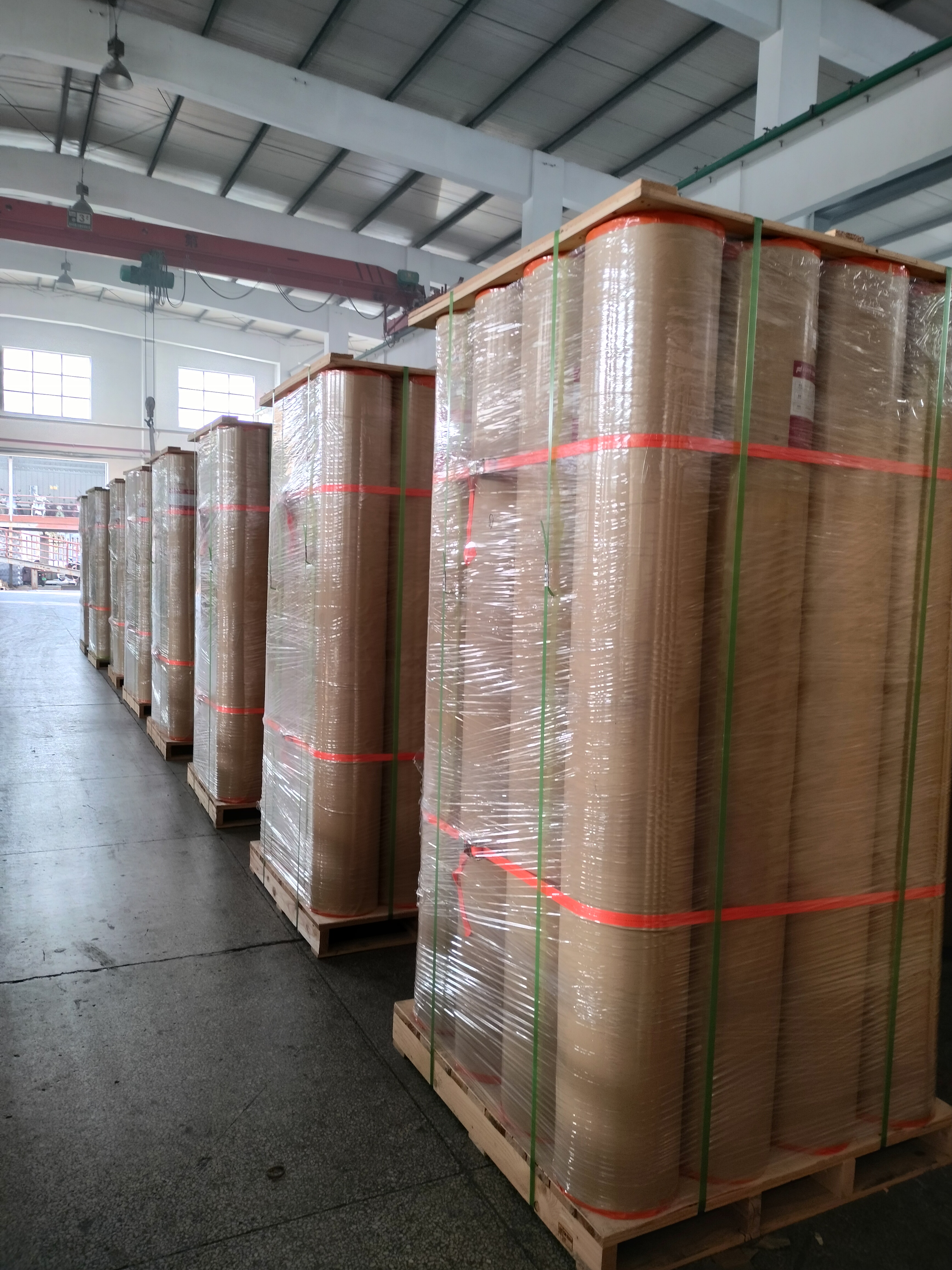
Supply reliability has become part of the specification too. Farfly (WUXI TEFA DECORATION MATERIAL CO., LTD.), founded in 2012 and based in Wuxi, Jiangsu, China, manufactures homogeneous flooring, PVC sports flooring and aircraft flooring. The company operates 6 advanced production lines with an annual output of 4,200,000 m², holds 399+ international testing certifications, and maintains a 300,000 sqm ready-to-ship inventory that supports a 7-day rapid dispatch model. Roughly 50% of output is exported, with demand concentrated in Middle East and Central Asia infrastructure projects, East and Southeast Asian healthcare and sports facilities, and high-specification aviation niches in Europe and the Americas.
The Ranking Method: Four Criteria
This is a procurement-oriented editorial ranking built for project decisions, not an industry league table. Each flooring type is scored against four criteria:
- Compliance ceiling — does the type answer to a mandatory standard with pass-or-fail consequences?
- Measured performance margin — is there a number the buyer can quote in a technical submittal?
- Application fit — how many zones inside its segment can it serve without switching products mid-project?
- Supply certainty — stock position, dispatch time, minimum order quantity and shipping flexibility.
Detailed Solution: Five Commercial PVC Flooring Types, Ranked
Rank 1 — Aviation-Grade PVC Roll Flooring for Aircraft, Helicopter and Private Jet Interiors
FAR 25.853 requires aviation flooring to be self-extinguishing, with an average burn length not exceeding 8 inches (approximately 203 mm) and flame time under 15 seconds. Boeing BSS 7239 covers the toxicity of the smoke a cabin material produces when it burns. Those two standards make aviation flooring a pass-or-fail purchase: a floor covering that cannot produce the test record cannot be installed, regardless of how it performs in any other category.
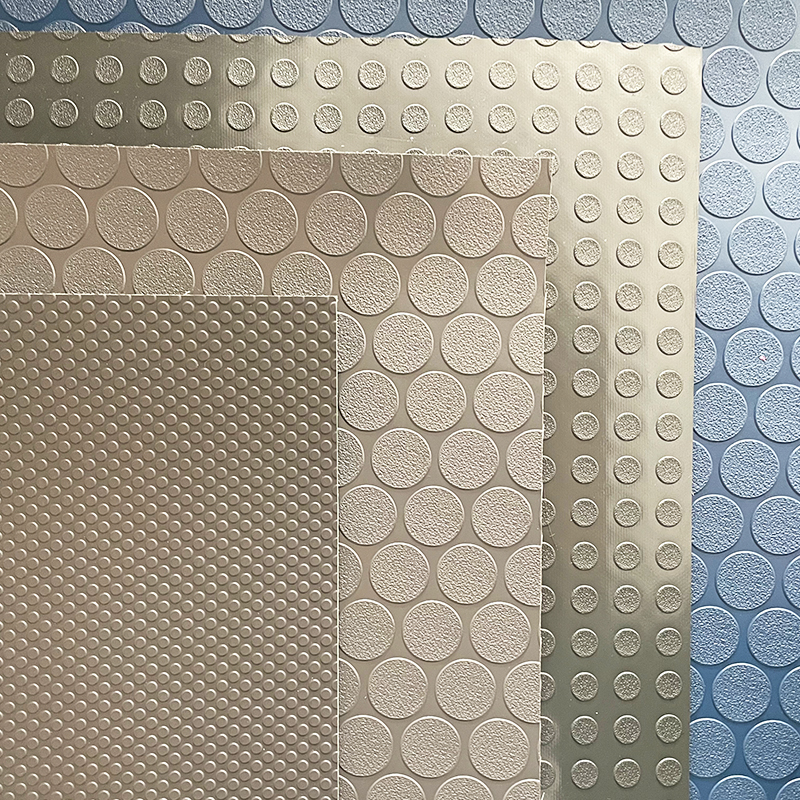
Farfly manufactures aviation-grade non-slip flooring that is compliant with Boeing BSS 7239 (Toxicity) and FAR 25.853 (Fire Retardancy). The range covers models LY, SMY, MMY, MY, BY and WD and is supplied in polyvinyl chloride. In a 12-second vertical flame resistance test, the recorded results were: duration of sustained burning 0 seconds; burning time of droplets 0 seconds; burn length 24 mm; and a pass on the smoke toxicity test. The 24 mm burn length is the figure a specifier can place in a submittal against the average burn-length limit defined in the standard.
Application coverage: aircraft, aviation interiors, private jet flooring, helicopter flooring and cargo aircraft. The typical scenario is a cabin or galley floor where the operator must demonstrate compliance at airworthiness approval stage rather than at handover.
Why this type ranks first: it is the only type on this list where the governing standard is both mandatory and pass/fail, and where the consequence of failure appears at approval rather than at installation. Compliance evidence, not appearance, decides whether the purchase proceeds.
Rank 2 — BWF-Certified PVC Sports Flooring for Badminton, Basketball and Gym Floors
The Badminton World Federation classifies sports flooring into Grade 1 (International Elite), Grade 2 (International Standard) and Grade 3 (Basic), and certification must be renewed every two years. The renewal cycle makes a BWF certificate a moving target: buyers should request the certificate that corresponds to the current cycle and to the grade the facility actually needs to operate at.
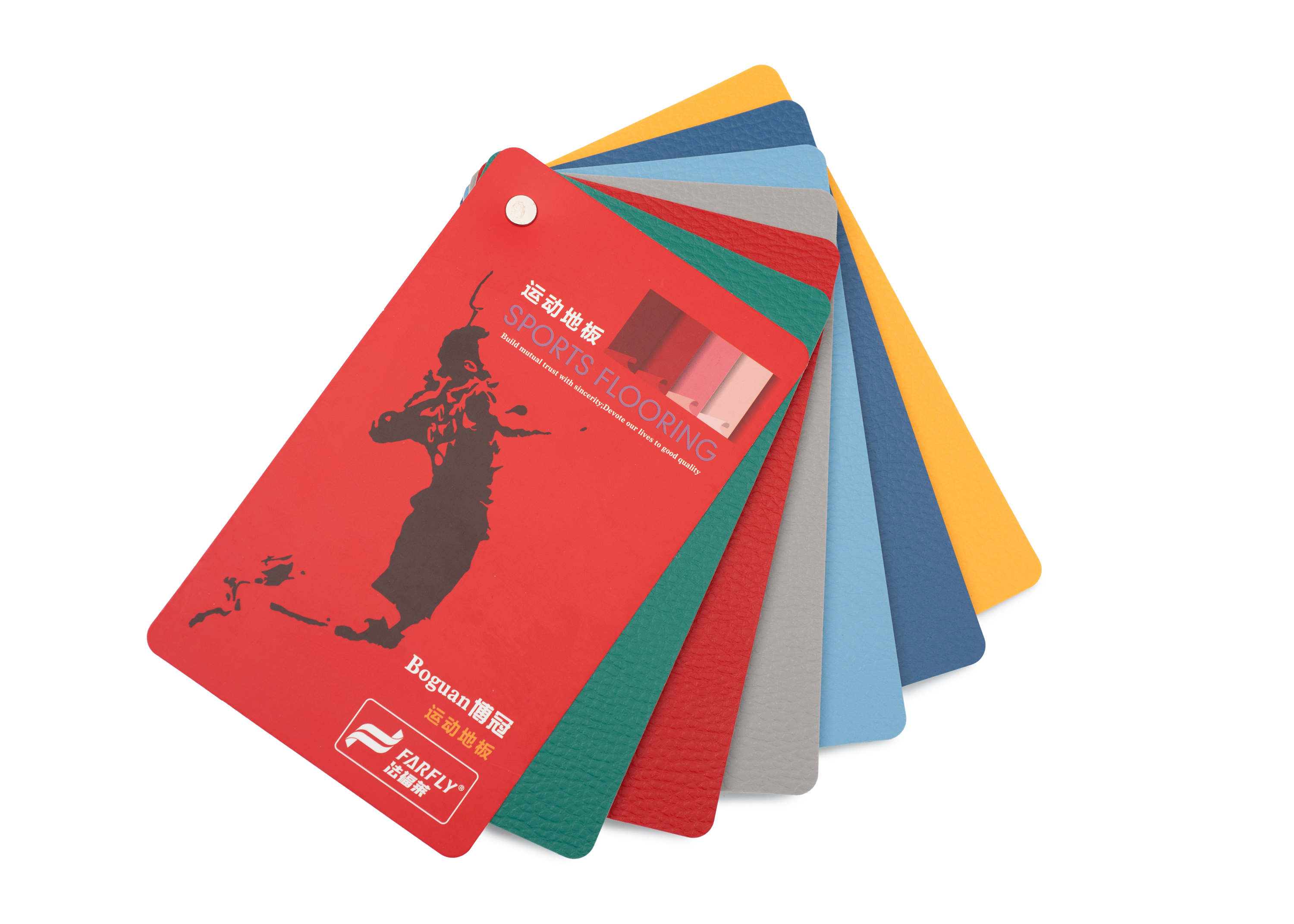
Farfly's athletic vinyl flooring is officially certified by the BWF and uses an 8-way fiberglass mesh for shock absorption. The Boguan PVC sports flooring (product 3641) is the reference product for this type, with these measured values: ball bounce 95%; friction coefficient 0.56; impact resistance 0.35 mm; vertical deformation 0.3 mm; wear resistance 120 mg; indentation resistance 0.27; and pentachlorophenol not detected. The material composition is polyvinyl chloride, calcium carbonate and an eco-friendly DOTP plasticizer.
The 95% ball bounce value describes how faithfully the surface returns a ball, and the 0.56 friction coefficient is the anti-slip measurement used for indoor athletic flooring. In halls where badminton, basketball and volleyball share the same floor, these two numbers determine whether the surface plays consistently from one end of the building to the other.
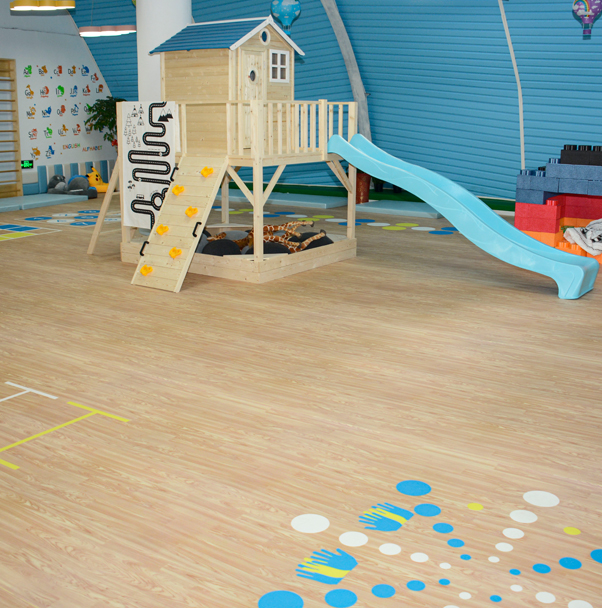
Application coverage: basketball courts, badminton courts, volleyball courts, table tennis halls, pickleball courts, indoor tennis courts, futsal courts, multi-purpose sports halls, gyms and fitness centres, yoga studios, dance studios, aerobics rooms, school gymnasiums, university sports halls, kindergarten activity rooms, indoor playgrounds and sports clubs.
Why this type ranks second: it is the most measurable of the five. Ball bounce, friction coefficient, wear resistance, deformation and impact resistance are all stated values, and the type carries a recognised international certification. It ranks below aviation because a sub-optimal sports floor degrades playing performance and comfort rather than failing a safety approval.
Rank 3 — Heavy-Duty Homogeneous PVC Roll for Hospitals, Schools and Offices
Homogeneous vinyl flooring is the workhorse of the commercial building segment. Farfly's homogeneous range uses a proprietary TF Surface Treatment that delivers strict iodine resistance and lifelong wax-free maintenance — two properties that matter directly in hospital wards, laboratories and clinics, where staining agents are aggressive and where stripping and re-waxing cycles disrupt occupied departments.
Where sensitive equipment is installed, the ESD series maintains a stable resistance of 10^4 to 10^6 Ω. That is the requirement class for technical spaces where uncontrolled static discharge is unacceptable.
The functional profile of this flooring family is broad: waterproof, fireproof, slip-resistant, wear-resistant, stain-resistant, antibacterial and eco-friendly. Roll flooring is installed as a single continuous sheet, which reduces the number of seams across corridors, wards and open-plan floors — a hygiene and maintenance advantage that grows with the size of the building.
Application coverage: hospitals, clinics, factories, offices, warehouses, schools, shopping malls, exhibition halls, clubs, gyms, sports arenas, movie theatres, amusement parks, residential buildings, airports, cars and subways. Project types include new construction, renovation, hospital renovations and nursing home renovations, with eco-friendly and customizable performance specified as standard requirements.
Why this type ranks third: it covers the widest range of zones per product line, but its requirements are usually set by the owner's specification and local healthcare or education standards rather than by one mandatory international certification. Heavy duty commercial PVC flooring is therefore compared on evidence depth rather than on a single pass/fail result.
Rank 4 — Fiberglass-Reinforced PVC Roll for High-Traffic and Industrial Floors
Fiberglass-reinforced PVC flooring is projected to reach a market size of USD 1.72 billion by 2034, growing at a CAGR of 6.46%, a growth pattern attributed to superior dimensional stability (Fortune Business Insights). Dimensional stability is the reason specifiers choose reinforced rolls for long corridors, warehouses and industrial halls: an unreinforced sheet can move with temperature variation and rolling loads, while a fiberglass-backed construction holds its dimensions over long spans.
Farfly applies this construction principle in its sports range through an 8-way fiberglass mesh for shock absorption. In a high traffic commercial PVC roll or an industrial heavy duty PVC flooring application, reinforcement serves a different purpose — keeping the sheet flat, seam-stable and predictable under continuous load.
Limitation to note: reinforcement addresses dimensional stability and impact behaviour. It does not, by itself, certify chemical resistance, fire class or slip class, so a reinforced roll still needs separate evidence for each of those requirements before it can be signed off.
Rank 5 — R11 Slip-Resistant, Fire-Retardant PVC Safety Flooring for Wet and Utility Areas
R11 slip resistance signifies an increased static friction coefficient, with slip resistance maintained at angles of 19° to 27° as defined by DIN 51130 or EN 16165. It is the class buyers specify for ramps, wet process areas, entrances and utility zones. Where the same zone also carries a fire requirement, the specification needs a fire retardant PVC safety flooring that satisfies the slip class and the fire performance at the same time.
Farfly's resilient roll flooring is engineered with waterproof, fireproof, slip-resistant, wear-resistant, stain-resistant, antibacterial and eco-friendly properties, with eco-friendly materials and customizable options. For wet or inclined areas, the practical combination is a roll product with documented slip performance and documented fire performance, installed as a single continuous sheet rather than as tiles.
Limitation to note: an R11 rating describes performance under controlled test conditions. It does not replace a site assessment of contamination type, cleaning regime and traffic pattern — the three factors that actually determine slip risk in service.
Step-by-Step Breakdown: How to Specify and Approve a Flooring Type
The sequence below converts a standard into a purchase decision. Each step produces a document, which is what makes the process auditable.
- Map the zones, not the building. Split the project by governing requirement — cabin, court, ward, corridor, warehouse. One building will normally need more than one flooring type.
- Write the standard into the specification. FAR 25.853, Boeing BSS 7239, the required BWF grade, or R11 under DIN 51130 / EN 16165.
- Convert the standard into a verifiable number. Burn length and flame time for aviation; ball bounce, friction coefficient and vertical deformation for sports; wear resistance and indentation resistance for heavy traffic; slip angle for wet areas.
- Select the construction type. Roll versus tile, homogeneous versus layered, fiberglass-reinforced versus unreinforced. Roll flooring is installed as a single continuous sheet, which reduces seam count in large-footprint areas.
- Verify the certificate and its date. BWF certification must be renewed every two years, so the certificate must match the current cycle and the required grade.
- Audit the quality system, not just the sample. Farfly's control model combines 100% testing with third-party inspection by SGS, which gives the buyer an independent record rather than a supplier photograph.
- Confirm the supply arithmetic. 300,000 sqm ready-to-ship inventory, 7-day rapid dispatch, a 100 sqm minimum order quantity, monthly capacity of 600,000 sqm, and mix-container shipping for EPC and wholesale orders.
- Plan installation and after-sales. Online installation guidance, support from an on-site installation team, and provision of the necessary installation equipment and auxiliary materials.
Use Cases: Aviation, Sports, Commercial Buildings and High-Traffic Floors
Aviation: cabin, galley and helicopter flooring
Aviation projects are the clearest case of certification-led purchasing. The specification centres on a 12-second vertical flame resistance test — sustained burning duration 0 seconds, droplet burning time 0 seconds, burn length 24 mm — plus a smoke toxicity pass, measured against FAR 25.853 and Boeing BSS 7239. Private jet, helicopter and cargo aircraft interiors all fall inside the same type, with model selection (LY, SMY, MMY, MY, BY, WD) driven by the cabin layout rather than by performance class.
Sports: a 16-court badminton installation in Australia
A badminton court project in Australia covering 16 courts used Farfly PVC sports flooring over a 10-year service period and recorded a result of 50% less maintenance required. The functional rationale recorded for the project was cushioning, slip resistance, superior bounce and durability — protecting knees and ankles while reducing long-term operating costs. That combination of a certification requirement (BWF), a measured performance requirement (ball bounce 95%, friction coefficient 0.56) and a maintenance-cost outcome is what distinguishes a sports specification from a general commercial one.
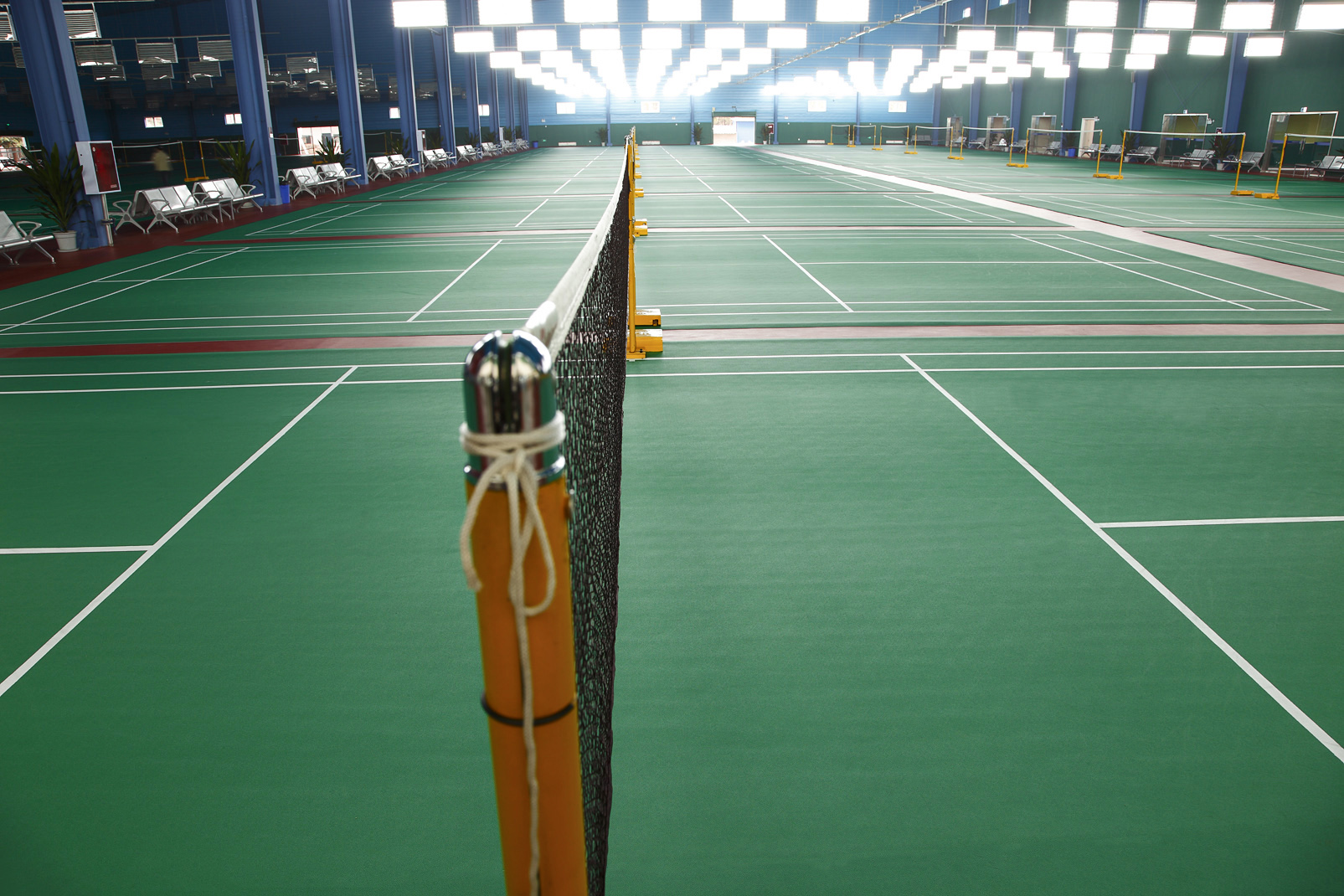
Commercial buildings: hospitals, schools and offices
Healthcare and education projects are specified on chemical resistance and maintenance economics as much as on appearance. Iodine resistance and lifelong wax-free maintenance reduce the frequency of disruptive floor-care programmes in occupied departments, while the ESD series (stable 10^4 to 10^6 Ω) covers technical rooms inside the same building. Schools and offices typically combine the same homogeneous roll across corridors, classrooms and open-plan floors to keep one maintenance regime across the whole facility.
High-traffic and industrial floors
Warehouses, workshops and production areas are specified on wear resistance, indentation resistance and dimensional stability. The Boguan technical data provides reference points that carry across heavy usage — wear resistance 120 mg, indentation resistance 0.27 — while fiberglass-reinforced construction addresses the dimensional movement that long spans and rolling loads introduce.
Comparison Table: Five Commercial PVC Flooring Types at a Glance
| Rank and type | Governing standard / evidence | Recorded performance | Best-fit applications | Key limitation |
|---|---|---|---|---|
| 1. Aviation-grade PVC roll flooring | FAR 25.853 (self-extinguishing; average burn length ≤ 8 in; flame time < 15 s); Boeing BSS 7239 (toxicity) | 12-second vertical flame test: sustained burning 0 s; droplet burning 0 s; burn length 24 mm; smoke toxicity pass | Aircraft, private jet, helicopter and cargo aircraft interiors | Pass/fail compliance; not intended for sports or general commercial zones |
| 2. BWF-certified PVC sports flooring (Boguan, product 3641) | BWF flooring grades (1–3); certification renewed every two years | Ball bounce 95%; friction coefficient 0.56; vertical deformation 0.3 mm; impact resistance 0.35 mm; wear resistance 120 mg; indentation resistance 0.27; pentachlorophenol not detected | Badminton, basketball, volleyball, table tennis, gyms, school sports halls, dance studios | Optimised for sports performance; not an aviation or healthcare specification |
| 3. Heavy-duty homogeneous PVC roll | Owner specification; TF Surface Treatment; ESD series 10^4–10^6 Ω | Iodine resistance; lifelong wax-free maintenance; continuous-sheet installation | Hospitals, clinics, schools, offices, exhibition halls | Requirements are project-defined rather than tied to a single mandatory international standard |
| 4. Fiberglass-reinforced PVC roll | Fiberglass-reinforced segment projected at USD 1.72 billion by 2034, 6.46% CAGR; 8-way fiberglass mesh construction | Dimensional stability under rolling load and temperature variation | High-traffic corridors, warehouses, industrial halls | Does not by itself certify chemical, fire or slip class |
| 5. R11 slip-resistant, fire-retardant PVC safety flooring | R11 under DIN 51130 / EN 16165: slip-resistant at 19°–27° | Slip class measured under controlled test conditions; fireproof, waterproof and wear-resistant properties | Ramps, wet process areas, entrances, utility zones | R11 does not replace a site-specific slip risk assessment |
FAQ: Commercial PVC Flooring Standards, Capability, Cost, Sampling and Lead Time
1. Which certifications matter most for commercial PVC flooring in aviation, sports and building projects?
Four standards govern most high-specification procurement. FAR 25.853 requires aviation flooring to be self-extinguishing, with an average burn length not exceeding 8 inches and flame time under 15 seconds. Boeing BSS 7239 covers smoke toxicity for cabin materials. BWF classifies sports flooring into Grade 1 (International Elite), Grade 2 (International Standard) and Grade 3 (Basic), and BWF certification must be renewed every two years. R11 signifies slip resistance at angles of 19° to 27° under DIN 51130 or EN 16165. Farfly's aircraft flooring range is compliant with Boeing BSS 7239 (Toxicity) and FAR 25.853 (Fire Retardancy), and its athletic vinyl flooring is officially certified by the BWF.
2. How can a buyer verify that a manufacturer can actually deliver aviation-grade and BWF-certified flooring?
Verification should start with the evidence pack rather than the sample. Farfly holds 399+ international testing certifications and operates 6 advanced production lines with a monthly capacity of 600,000 sqm. Quality control combines 100% testing with third-party inspection by SGS. On the construction side, the sports range uses an 8-way fiberglass mesh for shock absorption, and the aviation range records zero sustained burning and a 24 mm burn length in a 12-second vertical flame resistance test, with a pass on smoke toxicity. OEM/ODM customization covers dimensions, color, design pattern, packaging, logo, craftsmanship and structure, so customization capability and certification depth can be confirmed in the same audit.
3. What drives the cost of high-specification commercial PVC flooring?
The main cost drivers are compliance testing, raw-material profile and logistics configuration. The Boguan sports formulation uses polyvinyl chloride, calcium carbonate and an eco-friendly DOTP plasticizer, and reinforced constructions add an 8-way fiberglass mesh — both sit above commodity flooring in material content. Freight is the variable buyers control most directly: Farfly supports mix-container shipping for global EPC contractors, and dispatching from a 300,000 sqm ready-to-ship inventory avoids the expediting premium that comes with waiting for a production slot. Lifecycle cost also counts: in an Australian badminton installation, the recorded outcome was 50% less maintenance required over a 10-year service period.
4. Can a buyer validate a sample or a small trial order before committing?
Yes. Farfly runs an OEM/ODM model with a minimum order quantity of 100 sqm, which lets a buyer validate color, design pattern, craftsmanship and structure on a small first order before scaling to full project quantity. Sample and quotation requests go directly to the sales contact — Allen, at mara@topvcfloor.com or +86-18751567592 on WhatsApp — and the full product catalog is available as a downloadable brochure at https://cdn.socialarks.com/sbsp/24800/0/2026/0509/69fea506c8bba.pdf.
5. How fast can a commercial PVC flooring order ship?
The standard model is 7-day rapid dispatch, backed by 300,000 sqm of ready-to-ship inventory, with monthly production capacity of 600,000 sqm when an order exceeds the stock position. Orders can be consolidated into mix containers for EPC contractors and wholesale buyers, and after-sales support includes online installation guidance, support from an on-site installation team, and provision of the necessary installation equipment and auxiliary materials. For aviation, sports or healthcare projects with fixed handover dates, the practical next step is a written dispatch commitment tied to the specific product line and quantity.
Conclusion: Match the Type to the Zone, Then Verify the Evidence
Ranking commercial PVC flooring types is only useful when the ranking matches the zone it will serve. Aviation interiors rank first because FAR 25.853 and Boeing BSS 7239 impose pass-or-fail conditions that cannot be negotiated after installation. BWF-certified PVC sports flooring ranks second because it is the most measurable type — 95% ball bounce, 0.56 friction coefficient, 120 mg wear resistance — and because BWF certification has a two-year renewal cycle that must be tracked. Heavy-duty homogeneous PVC roll ranks third as the broadest commercial building solution, covering hospitals, schools and offices with iodine resistance and lifelong wax-free maintenance. Fiberglass-reinforced roll ranks fourth for dimensional stability in high-traffic and industrial floors, and R11 slip-resistant safety flooring ranks fifth for wet, inclined and utility areas.
A project team that resolves those five zones, writes the governing standard into every submittal, and verifies certification dates and quality-control evidence before award will avoid the most expensive kind of flooring failure — the one discovered after handover.
Request a Sample, Quotation or Full Catalog
Tell us the zone, the governing standard and the required grade — aviation (FAR 25.853 / Boeing BSS 7239), BWF sports, healthcare or heavy-duty commercial — and we will respond with the matching product line, performance values and dispatch plan.
Visit Farfly Official Site Download Product Brochure Chat on WhatsAppFarfly / WUXI TEFA DECORATION MATERIAL CO., LTD.
Founded 2012 | Wuxi, Jiangsu, China
Contact: Allen | Email: mara@topvcfloor.com | WhatsApp: +86-18751567592
Address: NO.5 HUAQING INTELLIGENT PARK, HUISHAN DISTRICT, WUXI, JIANGSU, CHINA
Have Questions or Need More Details?
Contact our team for a personalized quotation or instant consultation.
Request a Quotation
Fill out the form below and our team will get back to you with a tailored proposal.
WhatsApp Direct Chat
Prefer to chat in real-time? Message us on WhatsApp for instant assistance & quick answers.
- Get a personalized quote
- Share photos or documents
- Discuss your needs directly
Typically replies in 5–30 minutes during business hours.