
Homogeneous Vinyl Flooring Selection Parameters: EN433, ISO 24346, DIN 51130 & REACH
Homogeneous Vinyl Flooring Selection Parameters: EN433, ISO 24346, DIN 51130 & REACH
Six test standards decide whether a homogeneous vinyl flooring roll is acceptable for a hospital, clinic, factory, office, school or gymnasium project: ISO 24346:2006 for overall thickness, EN 433:1999 for indentation resistance, DIN 51130:2014-02 and EN 14041:2018 for slip resistance, fire behaviour and CE conformity, ISO 22196:2011 for antibacterial performance, ISO 16000-9:2006/Cor1:2007 for TVOC emission, and EU REACH regulation 1907/2006/EC for the 205 substances of very high concern (SVHC). This guide converts each standard into a selection parameter that can be written into a specification and verified against a named certificate.

Why a certificate pack is not a specification
Procurers rarely buy standards. They buy a floor that must stay flat under a hospital bed, survive trolley traffic in a corridor, resist iodine spills in a treatment room, and pass an indoor air quality check before handover. A certificate pack answers a different question: what was measured, on which product, by which method, and for which market.
Three failures appear repeatedly when specifiers convert a supplier's documentation into a decision.
1. A standard number without a parameter value. Listing “ISO 24346:2006” confirms that overall thickness was determined using a defined method. It does not state the thickness, and it does not state whether the thickness tested is the thickness being supplied.
2. A performance figure without a test method. Electrical resistance ranges are the clearest example. A stated range such as 10⁸–10⁶ Ω only becomes comparable when the resistance type (surface or volume), electrode configuration, conditioning and product code are specified. Without those, two suppliers can quote numbers that look similar and mean different things.
3. A certificate without product scope. Test reports are issued against a construction, a thickness and often a specific market. A report that is valid for one series does not automatically transfer to another series, colour or backing.
Industry background: how homogeneous vinyl reached the specification stage
Commercial sheet vinyl generally comes in two forms: heterogeneous and homogeneous. Homogeneous sheet vinyl is a single-layer construction with consistent colour and pattern running through the depth of the product. That construction has two practical consequences for a specification. It gives consistent wear and durability across the life of the floor, and it offers less design variety than heterogeneous sheet. Because the design is not a printed surface layer, homogeneous sheet is commonly positioned where wear-through resistance and long service life are prioritised over decorative range.
Healthcare and technical environments pushed the category further. Homogeneous vinyl flooring is now offered with conductive or static-dissipative properties for healthcare, pharmaceutical, life-science and industrial settings, and static-control variants are specified for laboratories, hospitals, server rooms and other ESD-sensitive areas.
Two European layers sit on top of product performance. Floor coverings placed on the EU market are covered by CE marking under EN 14041:2018, and REACH regulation 1907/2006/EC places obligations on substances of very high concern. A specification that only lists physical performance and ignores these two layers tends to fail at the compliance stage of a tender rather than at the technical stage.
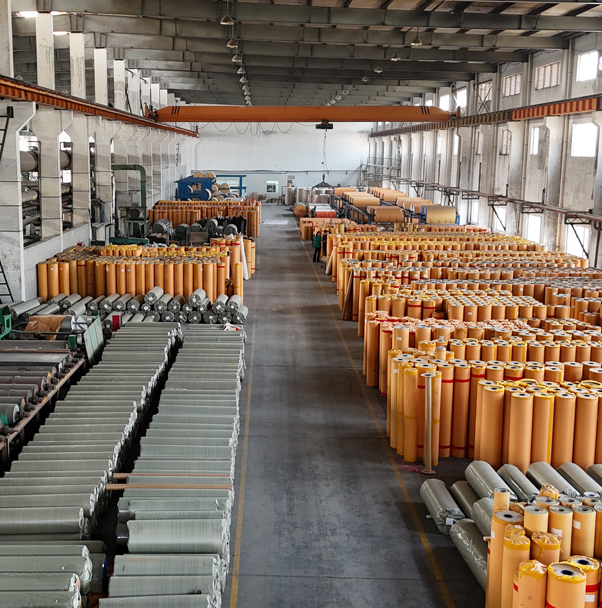
FARFLYING FLOORING is the resilient flooring brand of WUXI TEFA DECORATION MATERIAL CO., LTD., a manufacturer established in 2012 in Wuxi, Jiangsu, China, producing homogeneous vinyl flooring, PVC sports flooring and aircraft flooring, with 6 production lines and a stated annual output of 4,200,000 m².
The eight parameters, and the evidence behind each one
Each section below states what a parameter decides, which standard defines the measurement, what FARFLYING FLOORING declares or certifies for its homogeneous vinyl roll, and what the specifier should write into the tender.
Parameter 1 — Overall thickness (ISO 24346:2006)
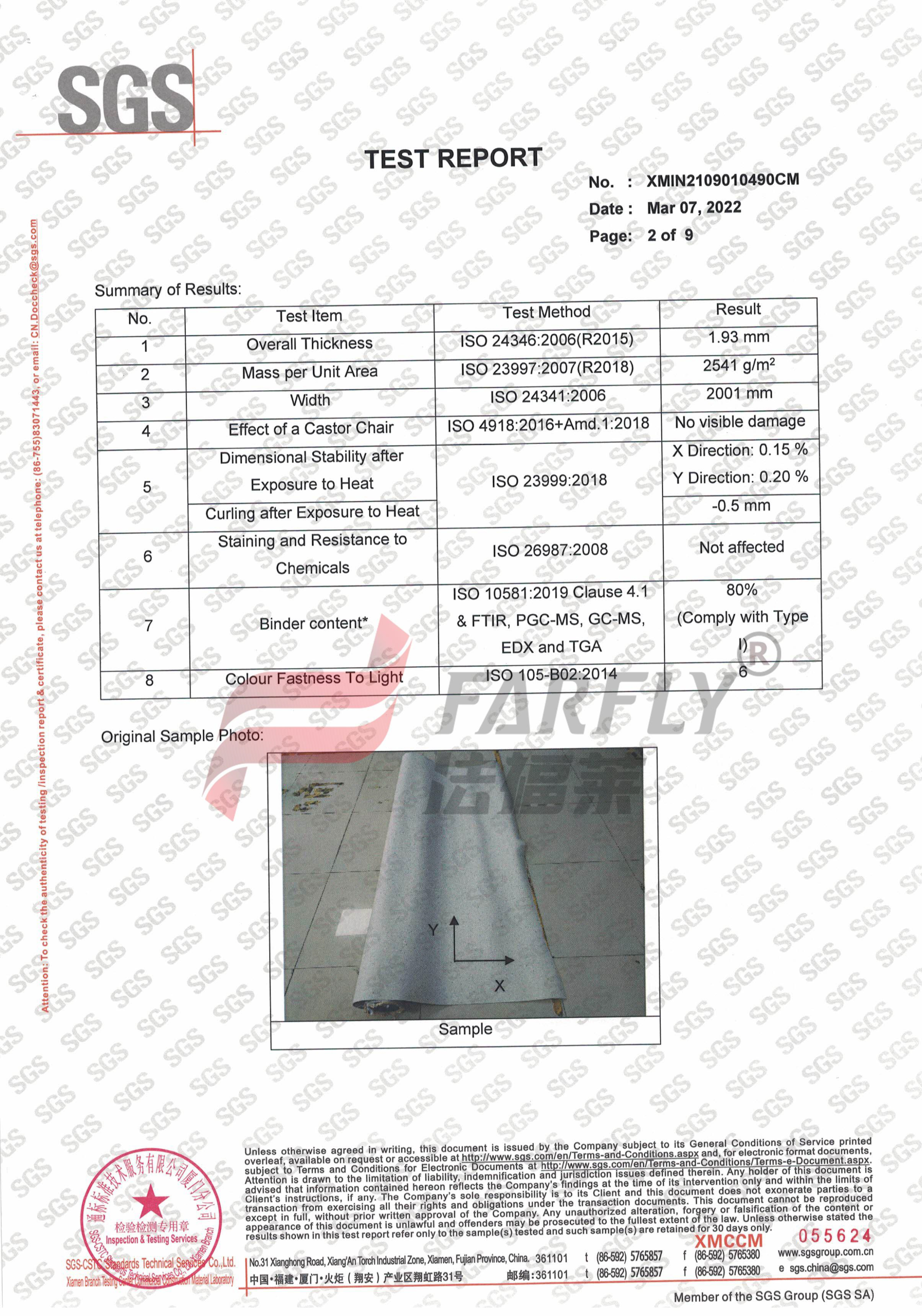
Overall thickness is the base figure from which indentation behaviour, rolling-load tolerance and joint detail are derived. ISO 24346:2006 defines the method for determining the overall thickness of a resilient floor covering, so a thickness claim without the standard behind it is not verifiable.
For the FARFLYING FLOORING homogeneous vinyl roll, the standard thickness is 2 mm, customizable to 2.5 mm or 3 mm, supplied in 2 × 20 m rolls. SGS test report XMIN2109010490CM covers ISO 24346:2006 together with ISO 23997:2007, ISO 4918:2016, ISO 29333:2018, ISO 26987:2008, ISO 10581:2019 and ISO 105-B02:2014, and is issued for the EU market.
What to write: the required thickness, the permitted range, and the instruction that the tested thickness on the certificate must match the delivered product code.
Parameter 2 — Residual indentation (EN 433:1999)
Residual indentation measures the permanent mark left after a static load is removed. It is the parameter that governs whether a floor keeps a flat, cleanable surface under beds, trolleys, equipment feet and stacked furniture. EN 433:1999 is the standard used to evaluate resistance to pressure marks and deformation, dimensional recovery and suitability for high-traffic environments.
The FARFLYING FLOORING homogeneous vinyl flooring declares a residual indentation of 0.06 mm. SGS report XMIN2109010491CM certifies the product to EN 433:1999, issued 7 March 2022 for the EU market.
What to write: the maximum permitted residual indentation, the test standard, and the tested thickness. Indentation results are thickness-dependent, so a 2 mm certificate and a 3 mm supply need to be reconciled before the order is placed.

Parameter 3 — Slip resistance, fire behaviour and CE conformity (DIN 51130:2014-02 and EN 14041:2018)
DIN 51130:2014-02 is a ramp test method, and the R classifications used in flooring tenders (R9, R10, R11 and above) originate from that test. The declared anti-slip property of the FARFLYING FLOORING homogeneous roll is R9.
SGS report XMIN2109010492CM covers DIN 51130:2014-02 in the same document as EN 13893:2002, EN 684:1995, EN 14041:2018, EN 1815:2016, EN 13501-1:2018, EN ISO 9239-1:2010 and EN ISO 11925-2:2020. In practical terms, that single report addresses slip resistance, wear resistance, electrostatic performance, fire resistance, ignition behaviour, radiant heat resistance and CE compliance for the tested construction.
CE conformity for the product is held under EN 14041:2018, certificate TCF-OY20250623-CPR, issued by ICR Co. Ltd. on 26 June 2025 and valid to 25 June 2030. The declared fire rating of the homogeneous vinyl roll is B-S1.
Parameter 4 — Antibacterial performance (ISO 22196:2011)
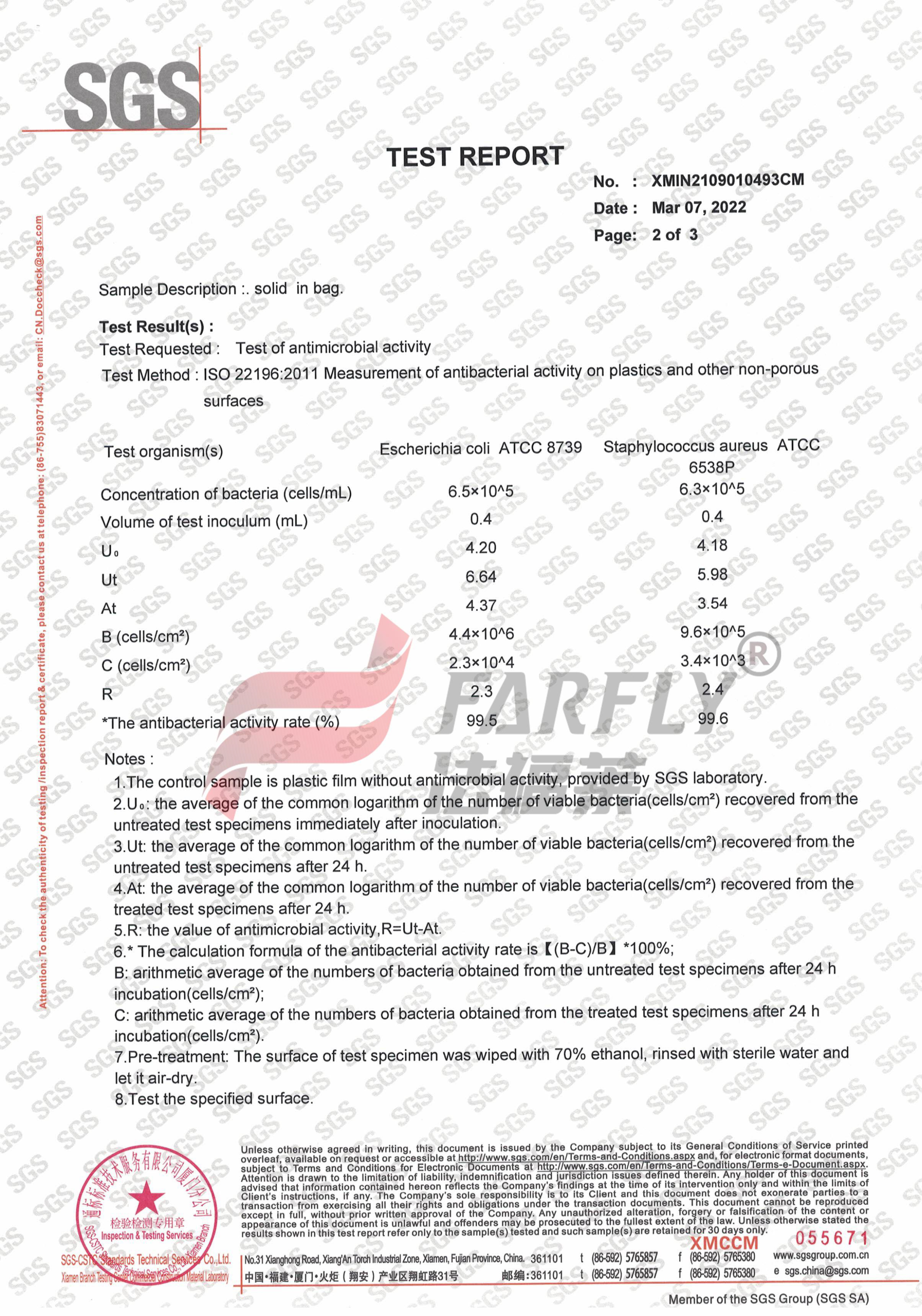
ISO 22196:2011 is the recognised method for measuring antibacterial activity on non-porous surfaces. It quantifies the reduction of bacteria on the flooring surface and supports hygienic positioning for healthcare and food-adjacent environments.
The FARFLYING FLOORING homogeneous vinyl flooring declares an antibacterial performance of 99.50%. SGS report XMIN2109010493CM certifies the product to ISO 22196:2011.
What to write: the standard, the required reduction figure, and the product code tested. A percentage quoted without the standard and without the tested product code cannot be verified during a site inspection or an audit.
Parameter 5 — TVOC emission over 28 days (ISO 16000-9:2006/Cor1:2007)
ISO 16000-9:2006/Cor1:2007 evaluates volatile organic compound emissions from flooring under controlled indoor conditions. It measures indoor air quality performance, low-emission characteristics and environmental safety, and it is the parameter that hospitals, schools and cleanroom projects increasingly use as a pass or fail gate before handover.
The FARFLYING FLOORING homogeneous vinyl flooring declares a TVOC (28 day) value of less than 10 µg/m³. CTC certificate WT2020B01A03405 covers the TVOC emission rate at 28 days under ISO 16000-9:2006/Cor1:2007, issued 12 June 2020 and applied globally.
What to write: the emission test, the 28-day measurement point, the acceptance value, and a requirement that the report corresponds to the supplied thickness and construction.

Parameter 6 — Substances of very high concern under EU REACH (1907/2006/EC)
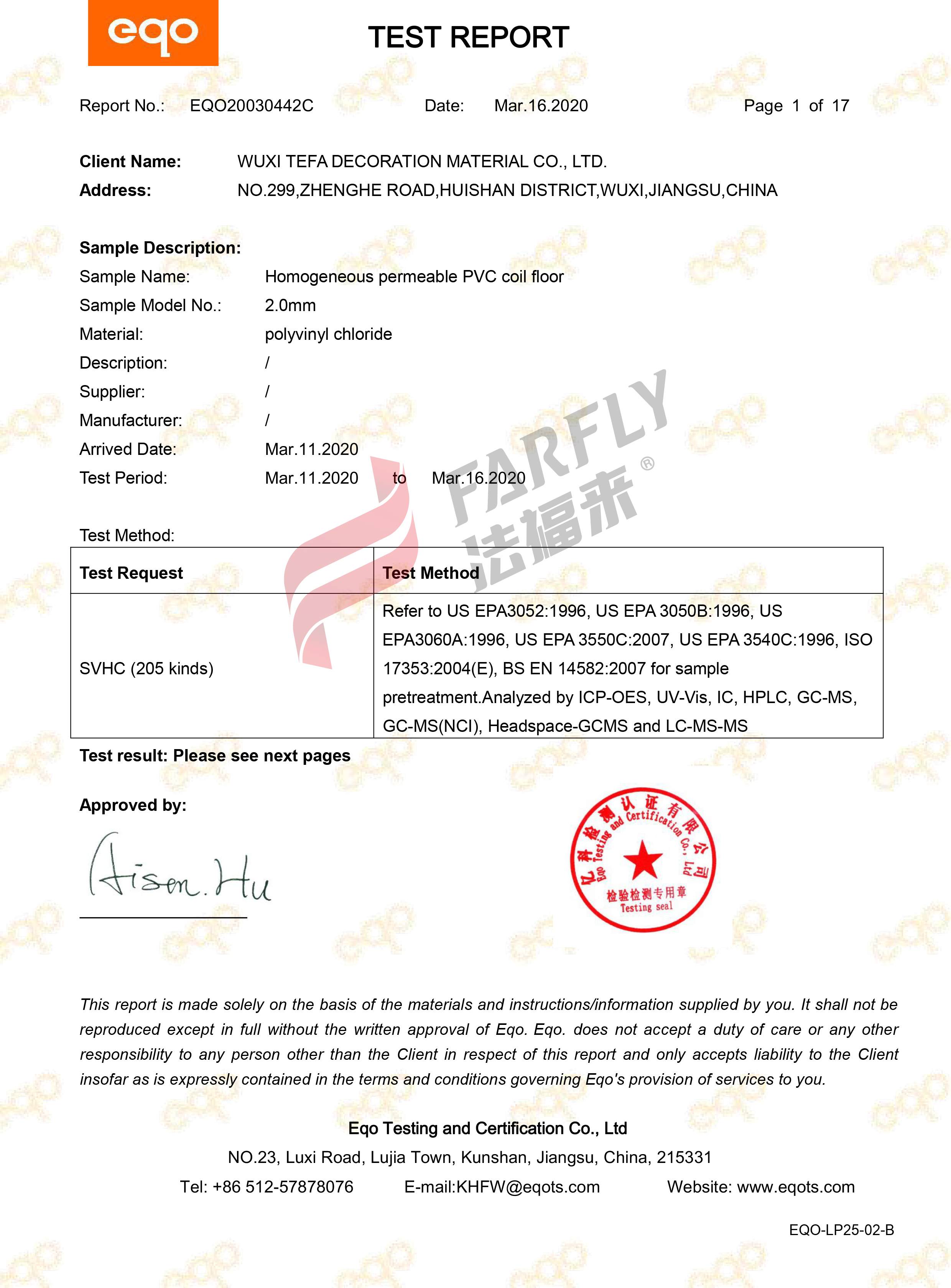
EU REACH regulation 1907/2006/EC governs substances of very high concern. For a flooring importer or a European project buyer, the relevant evidence is a test report that states the substance-list version tested and clears the product against that list.
The FARFLYING FLOORING vinyl flooring is certified to EU REACH regulation 1907/2006/EC for 205 kinds of SVHC. The certificate number is EQO20030442C, issued by EQO on 16 March 2020, applicable to the European Union market.
What to write: the required substance-list version, the certificate number, and a clause requiring the certificate to remain valid at the time of shipment. Certificates record the list version tested, so the tested version should be checked against the tender requirement rather than assumed.
Parameter 7 — Abrasion and wear group (EN ISO 10581 / Group T)
Wear classification is often quoted as a letter without explanation. Under EN ISO 10581, homogeneous vinyl flooring is classified as Wear Group T when volume loss is 2.0 mm³ or less per 100 revolutions in the Frick-Taber test (EN 660-2); Group P covers the range from 2.0 to 4.0 mm³ per 100 revolutions. Group T is therefore the relevant class where heavy footfall, trolley traffic and abrasive cleaning regimes apply.
The FARFLYING FLOORING homogeneous vinyl flooring declares abrasion resistance of Group T, together with chemical resistance rated as good and a material composition of polyvinyl chloride, calcium carbonate and eco-friendly DOTP plasticizer.
What to write: the wear group, the classification standard, and confirmation that the group applies to the supplied colour and thickness, since classification is a product-level statement.
Parameter 8 — Electrical resistance for ESD and static-control areas
ESD flooring is specified by resistance range, not by product name. The FARFLYING FLOORING ESD series maintains stable electrical resistance between 10⁴ and 10⁶ Ω.
Step-by-step: turning a certificate pack into a specification
The following workflow converts supplier documentation into a parameter sheet that survives tendering, substitution requests and site inspection.
- Step 1 — Classify every room by function, not by floor area. Separate wards, operating rooms, laboratories, corridors, entrances, production halls, offices, classrooms and sports halls. Each group has a different dominant parameter: hygiene and indentation in wards, chemical resistance and static control in laboratories and electronics areas, slip resistance at entrances, emission values in enclosed occupied spaces.
- Step 2 — Convert each requirement into a testable parameter with a method. “Low emission” becomes “TVOC at 28 days under ISO 16000-9:2006/Cor1:2007”. “Hard-wearing” becomes “Wear Group T under EN ISO 10581”. “Slip-resistant” becomes “DIN 51130:2014-02, R group stated per area”.
- Step 3 — Match each parameter to a named certificate and a product code. Record the certificate number next to the parameter. For FARFLYING FLOORING homogeneous vinyl, that mapping is XMIN2109010490CM (ISO 24346:2006), XMIN2109010491CM (EN 433:1999), XMIN2109010492CM (DIN 51130:2014-02 and EN 14041:2018), XMIN2109010493CM (ISO 22196:2011), WT2020B01A03405 (ISO 16000-9:2006/Cor1:2007) and EQO20030442C (REACH 205 SVHC).
- Step 4 — Check market applicability. Some certificates are issued for the EU market and others globally. A project in the Gulf or Southeast Asia may accept an EU-market certificate as technical evidence, but the compliance route for the destination market still has to be confirmed separately.
- Step 5 — Check the dates. Note the issue date and validity of each document. The CE certificate TCF-OY20250623-CPR was issued on 26 June 2025 and is valid to 25 June 2030; the SGS reports were issued on 7 March 2022 and the REACH certificate on 16 March 2020.
- Step 6 — Validate with a sample and, for healthcare projects, a welded mock-up. Confirm that the sample colour and product code match the certificate, weld a trial seam for review by the infection-control or facilities team, and keep the sample reference for site comparison.
- Step 7 — Lock the parameter sheet into the tender documents and the delivery check. The same sheet used for evaluation should be used at goods-in inspection, so that substitutions are identified before installation rather than after handover.
Use cases: which parameter dominates in which building
Homogeneous vinyl flooring is used across hospitals, clinics, factories, warehouses, offices, schools, shopping malls, exhibition halls, electronics workshops and laboratories. The parameter priorities differ by space.
Hospitals. EN 433:1999 indentation governs beds, trolleys and mobile equipment; ISO 22196:2011 antibacterial performance and welded, coved detailing support hygiene and cross-contamination control; ISO 16000-9:2006/Cor1:2007 emission values matter in enclosed wards; DIN 51130:2014-02 applies at entrances and in wet zones; REACH documentation is required for the EU supply chain. A reference project in Colombia used 27,000 m² of homogeneous flooring across hospital floors, selected for antimicrobial and eco-friendly performance with the reported project outcome of 50% less maintenance required and a service life band of 10–20 years.
Clinics and treatment rooms. The FARFLYING FLOORING healthcare range uses TF Surface Treatment, positioned for iodine resistance and wax-free maintenance, alongside a declared chemical resistance rated as good. For a clinic, that combination changes the cleaning and maintenance plan rather than just the material list.
Factories and electronics workshops. Wear Group T and residual indentation carry the load; in electronics and static-sensitive areas the ESD series is specified within the 10⁴–10⁶ Ω range, with the five-point resistance check applied before comparison.
Offices. The dominant parameters are fire behaviour, declared as B-S1, TVOC emission, and wear life under chair castors and footfall. Slip resistance at R9 is normally sufficient for dry internal circulation.
Schools. Slip resistance, wear group and antibacterial performance are the practical trio, with fire behaviour and emission values required by most education authorities. Roll format with welded seams reduces joint build-up in corridors and canteens.
Gymnasiums and sports halls. Indentation under equipment and bleacher loads, plus slip resistance, drive the specification; homogeneous sheet also appears in multi-purpose sports and assembly areas where a hard-wearing, cleanable finish is required rather than a dedicated sports surface.
Comparison table: certificate to selection parameter
The table below maps each certificate held for the FARFLYING FLOORING homogeneous vinyl flooring to the standard it covers and the specification clause it supports. Only issued certificates and declared product data are listed.
| Certificate | Issuer | Standard covered | Selection parameter | Typical clause it supports |
|---|---|---|---|---|
| XMIN2109010490CM | SGS | ISO 24346:2006; ISO 23997:2007; ISO 4918:2016; ISO 29333:2018; ISO 26987:2008; ISO 10581:2019; ISO 105-B02:2014 | Overall thickness, dimensional stability, flexibility, wear, chemical resistance, colour fastness to light | Thickness and durability clause |
| XMIN2109010491CM | SGS | EN 433:1999 | Residual indentation (declared 0.06 mm) | Static load and equipment clause |
| XMIN2109010492CM | SGS | DIN 51130:2014-02; EN 13893:2002; EN 684:1995; EN 14041:2018; EN 1815:2016; EN 13501-1:2018; EN ISO 9239-1:2010; EN ISO 11925-2:2020 | Slip resistance (declared R9), fire and ignition behaviour (declared B-S1), electrostatic performance, CE compliance | Safety, fire and CE clause |
| XMIN2109010493CM | SGS | ISO 22196:2011 | Antibacterial performance (declared 99.50%) | Infection control clause |
| WT2020B01A03405 | CTC | ISO 16000-9:2006/Cor1:2007 | TVOC emission rate at 28 days (declared <10 µg/m³) | Indoor air quality clause |
| EQO20030442C | EQO | EU REACH 1907/2006/EC, 205 SVHC | Restricted substance screening | EU market access clause |
| TCF-OY20250623-CPR | ICR Co. Ltd. | EN 14041:2018 | CE conformity marking | Construction Products Regulation clause |
Declared product data for the same homogeneous vinyl roll is summarised below for direct use in a parameter sheet.
| Parameter | Declared value | Related standard or evidence |
|---|---|---|
| Thickness | 2 mm, customizable to 2.5 mm or 3 mm | ISO 24346:2006 (XMIN2109010490CM) |
| Roll dimensions | 2 × 20 m per roll | Product data sheet |
| Residual indentation | 0.06 mm | EN 433:1999 (XMIN2109010491CM) |
| Anti-slip property | R9 | DIN 51130:2014-02 (XMIN2109010492CM) |
| Fire rating | B-S1 | EN 13501-1:2018 covered in XMIN2109010492CM |
| Antibacterial performance | 99.50% | ISO 22196:2011 (XMIN2109010493CM) |
| TVOC (28 day) | Less than 10 µg/m³ | ISO 16000-9:2006/Cor1:2007 (WT2020B01A03405) |
| Abrasion resistance | T | EN ISO 10581 wear classification |
| Chemical resistance | Good | Product data sheet |
| ESD series resistance | 10⁴–10⁶ Ω | ESD series specification |
| Material | PVC, calcium carbonate, eco-friendly DOTP plasticizer | Product data sheet |
Frequently asked questions
Which certificate proves that a homogeneous vinyl floor meets EU REACH obligations for SVHC?
REACH compliance is evidenced by a test report that states the substance-list version covered. For FARFLYING FLOORING vinyl flooring, that document is certificate EQO20030442C issued by EQO, testing against EU REACH regulation 1907/2006/EC for 205 kinds of substances of very high concern, applicable to the European Union market. The certificate was issued on 16 March 2020. Buyers should confirm that the tested substance-list version matches the version referenced in their own tender documents.
Can a single homogeneous vinyl roll satisfy slip resistance, indentation and antibacterial requirements at the same time?
Yes, provided the requirements are written against separate standards and separate certificates. For FARFLYING FLOORING homogeneous vinyl flooring, SGS report XMIN2109010492CM covers DIN 51130:2014-02 for slip resistance, SGS report XMIN2109010491CM covers EN 433:1999 for indentation resistance with a declared residual indentation of 0.06 mm, and SGS report XMIN2109010493CM covers ISO 22196:2011 for antibacterial performance with a declared value of 99.50%. The critical check is that all three reports reference the same product code and the same thickness being supplied.
Is it worth specifying 2.5 mm or 3 mm instead of the standard 2 mm, and what does that change commercially?
The FARFLYING FLOORING homogeneous vinyl roll is supplied at 2 mm as standard, customizable to 2.5 mm or 3 mm. Commercially, the material decision is driven by the specification scope rather than by a single price figure: higher thickness and ESD construction both change the product configuration, and certification scope has to be aligned with the thickness supplied. Indentation performance, which is the parameter that most often justifies an upgrade, is certified under EN 433:1999 at a declared 0.06 mm. Because thickness, ESD grade and surface treatment all move together, the practical approach is to request a like-for-like quotation stating thickness, roll size, ESD grade and destination, so that the comparison is made on identical parameters.
How should a specifier validate a sample before tendering?
Order a sample in the exact colour and product code that will be supplied, then verify four things: that the sample reference matches the certificate numbers listed in the parameter sheet; that a welded seam can be produced to the standard required in the room, since healthcare and cleanroom specifications rely on welded joints and coved detailing; that the declared slip classification is appropriate for the specific area rather than for the building as a whole; and that the emission and antibacterial reports correspond to the construction being supplied. Keeping the approved sample on site gives the facilities team a reference point for delivery inspection.
What lead time should be planned for a certified homogeneous vinyl order?
FARFLYING FLOORING operates 6 advanced production lines with a monthly capacity of 600,000 m² and maintains a ready-to-ship inventory of 300,000 m², which supports a 7-day rapid dispatch model and mixed-container shipping for global contractors. The minimum order quantity is 100 m². Because international projects often combine several product types in one shipment, mix-container loading reduces the number of separate deliveries to site. To confirm availability for a specific colour and ESD grade, send the room schedule, thickness and target destination to mara@topvcfloor.com, or request a sample and quotation through the FARFLYING FLOORING website.
Conclusion
Homogeneous vinyl flooring passes or fails a project on parameters, not on adjectives. ISO 24346:2006 defines how overall thickness is measured; EN 433:1999 defines indentation resistance; DIN 51130:2014-02 and EN 14041:2018 cover slip resistance, fire behaviour and CE conformity; ISO 22196:2011 covers antibacterial performance; ISO 16000-9:2006/Cor1:2007 covers 28-day TVOC emission; and EU REACH 1907/2006/EC governs the 205 substances of very high concern that EU-bound projects must clear.
The practical discipline is to write each of those into the specification as a parameter with a method, a value, a product code and a certificate number — and then use the same sheet at goods-in inspection. Done that way, a hospital in Bogotá, a cleanroom in Southeast Asia and a school gymnasium in the Gulf are all evaluated against the same verifiable framework rather than against the thickness of a supplier's brochure.
Next step: request the parameter sheet and a sample
FARFLYING FLOORING supplies homogeneous vinyl flooring for hospitals, clinics, factories, offices, schools and gymnasiums, with SGS, CTC, EQO and CE documentation available for each parameter listed above. Send your room schedule with the required thickness, ESD grade and destination market, and we will return a parameter sheet matched to your certificate requirements, together with a sample and quotation.
Email: mara@topvcfloor.com | WhatsApp: +86-18751567592 | Website: topvcfloor.com
Download the full product catalogue: FARFLYING FLOORING product brochure (PDF)
Have Questions or Need More Details?
Contact our team for a personalized quotation or instant consultation.
Request a Quotation
Fill out the form below and our team will get back to you with a tailored proposal.
WhatsApp Direct Chat
Prefer to chat in real-time? Message us on WhatsApp for instant assistance & quick answers.
- Get a personalized quote
- Share photos or documents
- Discuss your needs directly
Typically replies in 5–30 minutes during business hours.