
Homogeneous Vinyl Flooring 101: Why Roll Flooring Fits Hospitals and Schools
Homogeneous vinyl flooring is a single-layer resilient floor covering supplied in rolls, in which color and pattern run through the full thickness of the material. That one structural detail explains most of its presence in healthcare and education buildings: there is no printed design layer sitting under a wear film, and the floor is installed as a continuous sheet with heat-welded seams rather than a grid of tile joints.
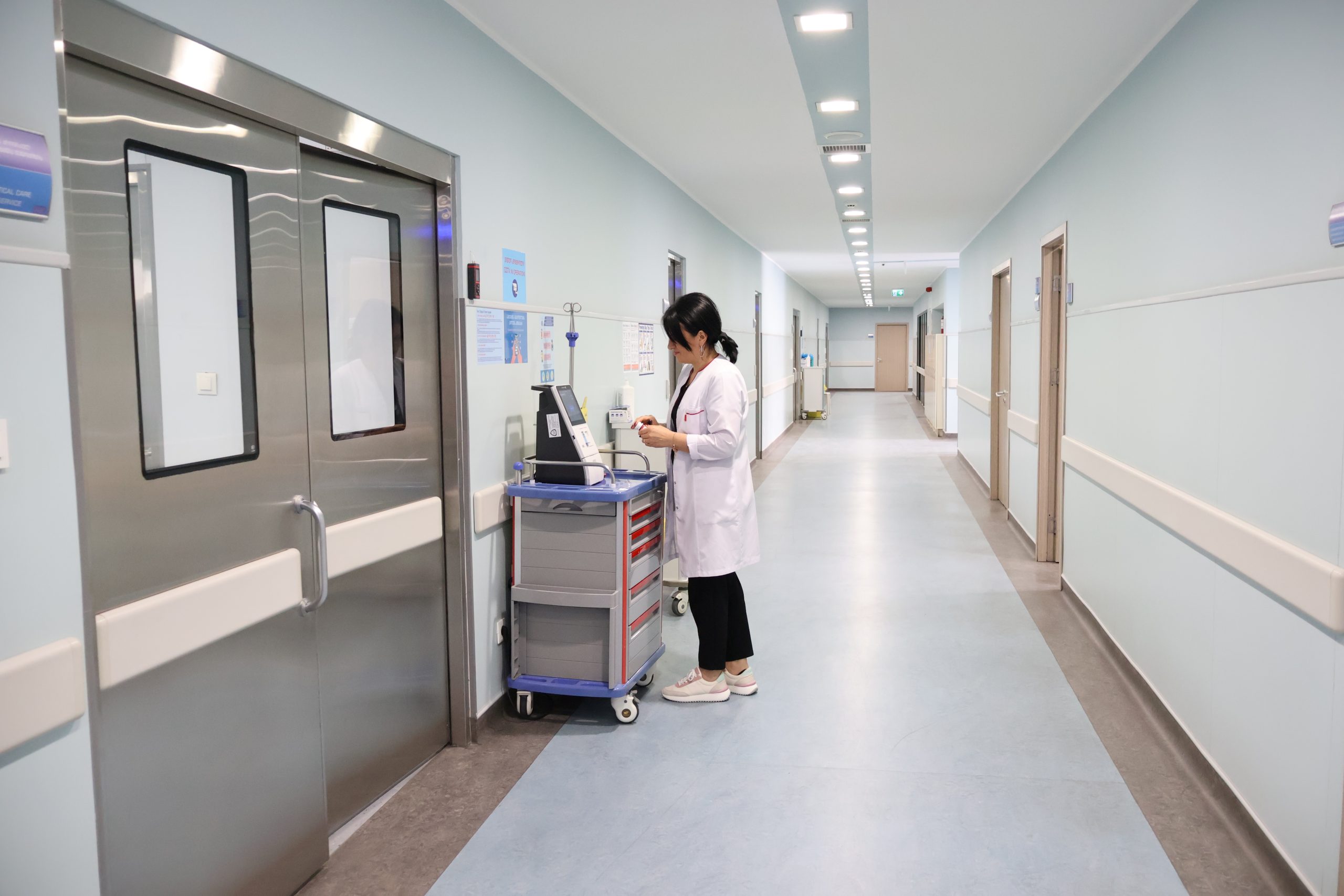
Homogeneous vinyl roll flooring in a healthcare setting: approximately 15,000 m² of 2.0 mm multi-color material installed at Jo Ann University Hospital in Tbilisi, Georgia, completed in early 2025.
What This Guide Has to Solve
First-time buyers usually approach “homogeneous vinyl flooring” as if it were one item on a price list. In practice it is three separate decisions that have to line up before a purchase order makes sense.
Decision 1 — construction. Homogeneous or heterogeneous? Both are commercial sheet vinyl. Homogeneous has a uniform composition through its thickness; heterogeneous stacks a wear layer, a printed design layer, a core and a backing. The answer changes what the floor looks like after years of trolley traffic in a hospital corridor or chair traffic in a school.
Decision 2 — format. Roll or tile? A roll covers a large area as one continuous sheet, which is what makes welded seams and coved skirting possible. A tile system in the same corridor produces hundreds of joints, and every joint is a place where soil and moisture collect.
Decision 3 — installation system. A roll floor is only as good as its substrate, adhesive, welding rod and detailing. Subfloor moisture, adhesive open time, groove depth, welding temperature and traffic-release time all live in the technical data sheet, not in the brochure.
The common failure is not picking the wrong brand. It is picking a product before deciding which of those three questions it is supposed to answer.
Industry Background: One Product Family, Two Constructions
Commercial sheet vinyl flooring generally comes in two forms: heterogeneous and homogeneous. Vinyl sheet itself is categorized by manufacturing process and content — homogeneous, inlaid and layered composite products. Homogeneous is the variant where the material is uniform from surface to backing: the color and pattern are not printed onto the top of the sheet, they are the sheet.
Two practical consequences follow. The first is wear behavior: because color and pattern run through the depth of the flooring, wear-through is far less visible than on a printed product, and the surface is generally described as more scratch resistant. The second is a trade-off that buyers should hear early: homogeneous construction offers less design variety than heterogeneous sheet, because a through-body pattern cannot reproduce a detailed graphic print.
Specification language for this product family is well established. EN ISO 10581 is the product specification for homogeneous PVC floor coverings. Abrasion resistance is classified into wear groups, with Group T defined as a volume loss of no more than 2.0 mm³ per 100 revolutions in the Frick-Taber test described in EN 660-2. Specifier guidance for institutional projects typically pairs a Group T rating with use class 34/43, the classes covering heavy commercial and industrial traffic, and describes healthcare installation as heat-welded joints with a flash cove turned up the wall.
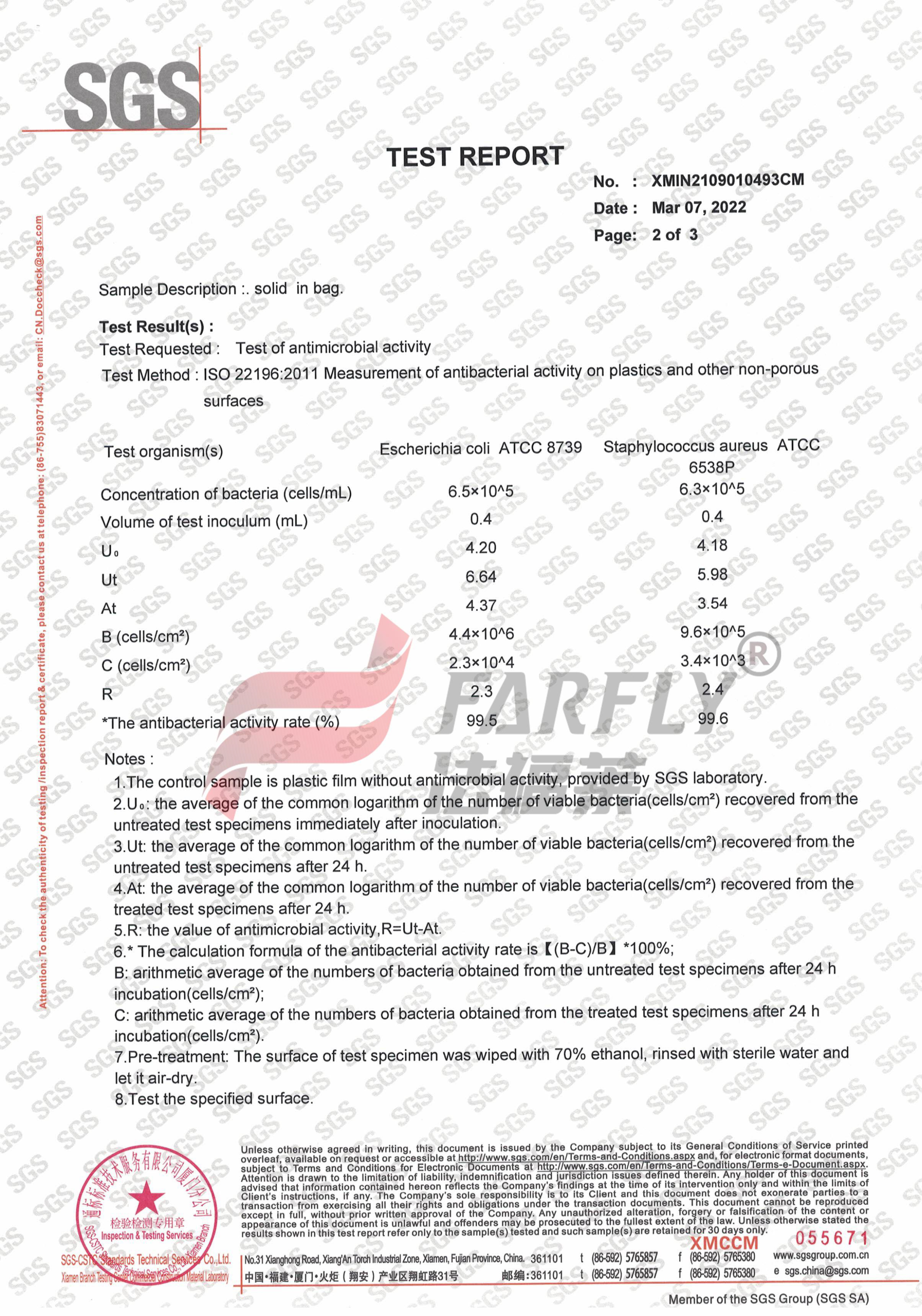
Antibacterial performance is a test result, not a slogan: the ISO 22196:2011 report held by Farfly measures bacterial reduction on the flooring surface (SGS report XMIN2109010493CM).
The Core Answer: Why Roll Flooring Suits Hospitals and Schools
1. Seams are the weak point, and rolls reduce them
Hygiene in a hospital or a school is largely a story about joints. A roll is installed as a single continuous sheet, and where two sheets meet, the seam is grooved and heat-welded with a matching welding rod so the finished floor behaves as one surface. Healthcare specification guidance goes a step further and describes a flash cove turned up the wall, which removes the floor-to-wall junction where dirt and moisture normally accumulate. A tile layout cannot deliver the same result, because every tile edge is a permanent joint.
2. Through-body construction survives trolleys and school shoes
In a homogeneous sheet the pattern exists at every depth. Scuffs and scratches therefore reveal more of the same material rather than a contrasting substrate, and wear appears as a gradual change rather than a visible patch. For schools — where the same corridor carries bags, chairs and cleaning machines for two decades — this is the property that keeps a floor presentable without replacement.
3. Cleaning regimes can drop the wax
Farfly’s healthcare homogeneous vinyl is produced with the company’s TF Surface Treatment, which the manufacturer positions for iodine resistance and wax-free maintenance. Iodine staining is a specific hospital problem, because iodine-based antiseptics are used constantly and many floors mark permanently. Wax-free maintenance matters in education budgets as well, where labor rather than material is the recurring cost.
4. Static control can live in the same building
Hospitals rarely need one floor; they need several, in one procurement. Imaging rooms, operating theaters and equipment areas may call for dissipative flooring, while wards and corridors do not. Farfly’s ESD series maintains resistance in the range of 10⁴ to 10⁶ ohms. A single project can therefore mix standard homogeneous roll for general areas with anti-static roll for critical rooms, keeping one installation method, one accessory set and one supplier. The Samarkand hospital package shows the pattern: roughly 10,000 m² of homogeneous vinyl for general areas and patient wards plus 2,000 m² of anti-static PVC for operating rooms, supplied together with compatible welding rods and adhesive.
5. Hygiene and indoor air quality can be tested
Two claims dominate healthcare flooring conversations — antibacterial performance and low emissions — and both are verifiable. ISO 22196:2011 measures the reduction of bacteria on a flooring surface. ISO 16000-9:2006 measures VOC emissions from flooring under controlled indoor conditions, which is the evidence a school authority or hospital engineering department asks for when a building has an indoor air quality target.
6. One system, one accountable supplier
Roll flooring is only finished when the accessories arrive with it: adhesive, welding rod in a matching color, coving profiles and installation guidance. FARFLYING FLOORING, the brand of WUXI TEFA DECORATION MATERIAL CO., LTD., is a resilient flooring manufacturer established in 2012 and based in Wuxi, Jiangsu, China, producing homogeneous flooring, PVC sports flooring and aircraft flooring. Its export business accounts for around half of output, with healthcare and sports projects concentrated in East and Southeast Asia and mega-infrastructure work in the Middle East and Central Asia. Hospital packages are shipped as complete systems rather than as loose rolls, which is the difference between a material delivery and an installable floor.
How Performance Is Proven, Not Claimed
For a first-time buyer the practical question is not “does the supplier say it is certified” but “which document covers the product and thickness I am buying”. Farfly’s documentation is organized by test standard, and each report carries an identifiable number.
| Standard | What it verifies | Report or certificate held by Farfly |
|---|---|---|
| EN 14041:2018, with DIN 51130:2014-02, EN 13893:2002, EN 684:1995, EN 1815:2016, EN 13501-1:2018, EN ISO 9239-1:2010, EN ISO 11925-2:2020 | CE-related performance for resilient floor coverings: reaction to fire, ignition behavior, radiant heat resistance, slip resistance and electrostatic behavior | SGS report XMIN2109010492CM; CE certificate TCF-OY20250623-CPR issued by ICR Co. Ltd., valid 2025-06-26 to 2030-06-25 |
| ISO 10581:2019, with ISO 24346:2006, ISO 23997:2007, ISO 4918:2016, ISO 29333:2018, ISO 26987:2008, ISO 105-B02:2014 | Homogeneous PVC classification, thickness, dimensional stability, flexibility, wear resistance, chemical resistance and color fastness to light | SGS report XMIN2109010490CM |
| ISO 22196:2011 | Antibacterial performance, measured as bacterial reduction on the flooring surface | SGS report XMIN2109010493CM |
| EN 433:1999 | Residual indentation and recovery under static loads from furniture, equipment and heavy traffic | SGS report XMIN2109010491CM |
| EU REACH (1907/2006/EC), SVHC list of 205 substances | Screening for restricted substances of very high concern | Certificate EQO20030442C issued by EQO |
| ISO 16000-9:2006 | VOC emission rate from flooring in a controlled chamber | Report WT2020B01A03405 issued by CTC |
| ISO 9001:2015, ISO 14001:2015, ISO 45001:2018 | Quality, environmental and occupational health and safety management systems covering the sale of decoration materials | Certificates 29524Q04072R0S, 29524E04073R0S and 29524S040725R0S issued by AUBURN |
Verification map compiled from Farfly’s certificate records. A report number is only useful when it names the product, thickness and production site being purchased — request the full document, not the logo.
Two cautions belong in any 101 guide. First, a CE certificate and a test report are not the same kind of document: the certificate confirms conformity against a harmonized standard, while the report records what a laboratory measured on a specific specimen. Second, a resistance range such as 10⁴ to 10⁶ ohms means very little without the test method, the conditioning and the product code — which is exactly why buyers should ask for reports rather than ranges.
Step-by-Step Breakdown: From Specification to a Finished Floor
Step 1 — Fix the application and the traffic class
Decide per room, not per building. A ward corridor, a classroom, a chemistry laboratory and a warehouse aisle are four different specifications. Group T wear resistance and use class 34/43 are reasonable starting points for heavy institutional traffic; ESD areas need their own resistance requirement written down before any quotation is requested.
Step 2 — Verify the substrate
Roll flooring follows the substrate it is glued to. The subfloor must be smooth, level, clean and dry, and its moisture content must sit inside the limits stated in the flooring and adhesive technical data. On renovation projects this step decides the schedule, not the material.
Step 3 — Acclimatize and dry-lay
Rolls are acclimatized and dry-laid before cutting, so pattern direction and sheet sequence are fixed on site. Measuring and marking centerlines at this stage prevents the narrow, awkward strips that later become difficult seams.
Step 4 — Apply the specified adhesive
The approved adhesive is applied with the specified trowel and left for its open time. Neither the trowel nor the open time is negotiable: both are set in the technical documentation for the product being installed.
Step 5 — Weld the seams
After the adhesive sets, seams are grooved and heat-welded with a matching welding rod, then trimmed flush. A correctly welded seam is continuous, close to invisible in a through-body pattern, and does not open under normal cleaning.
Step 6 — Detail the edges and coved work
Healthcare guidance describes a flash cove turned up the wall to remove the floor-to-wall junction. The same detailing principle applies in schools, laboratories and service areas where a mop is used daily.
Step 7 — Protect and hand over
Traffic, rolling loads and equipment stay off the floor until the adhesive, welds and any line marking have fully cured. On a live hospital site this is a scheduling problem that has to be agreed before installation begins, not during it.
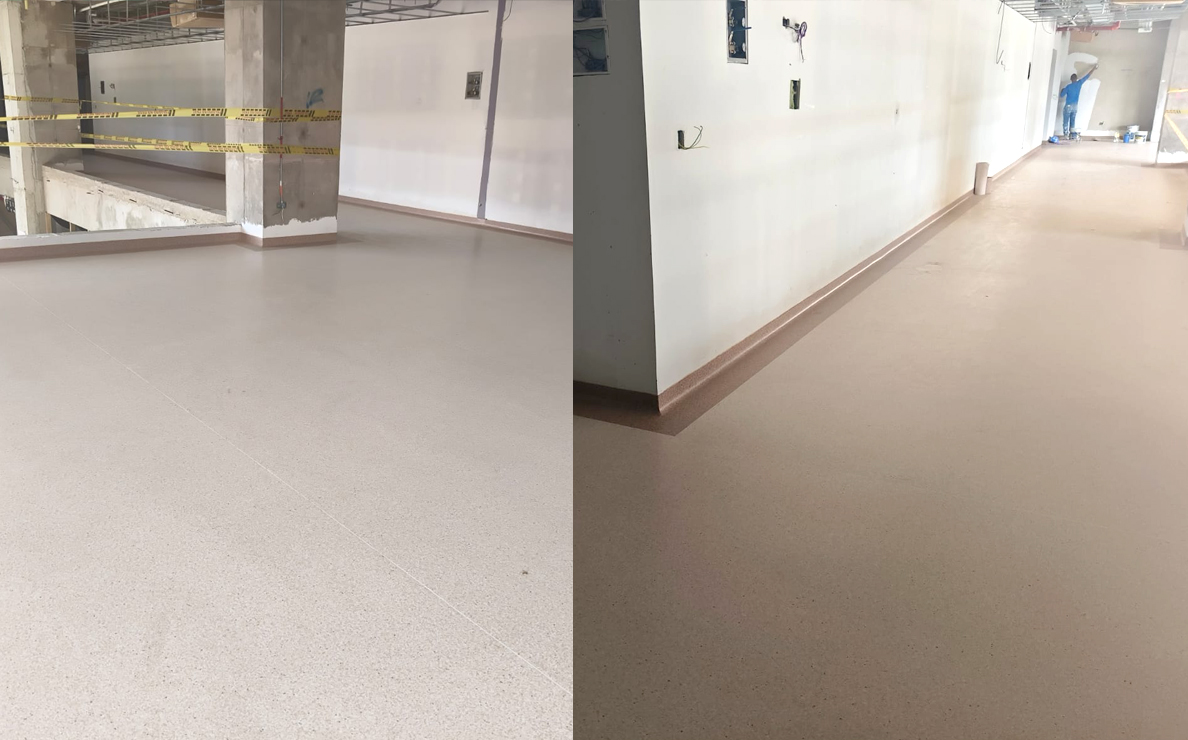
Welded homogeneous sheet in a hospital department. Continuous sheet plus welded seams is the detail that separates roll flooring from a tile layout in hygiene-critical areas.
Use Cases: Where Homogeneous Roll Flooring Is Specified
Hospitals and clinics
Wards, corridors, treatment rooms and operating theaters are the classic application. The combination that matters is a welded, coved surface for cleaning, iodine resistance for stain control, and optional ESD performance for rooms with sensitive equipment. Farfly’s hospital work in Tbilisi, Georgia covered approximately 15,000 m² of 2.0 mm multi-color homogeneous vinyl, using continuous sheet installation and heat-welded joints to distinguish functional areas while keeping one coordinated surface. Because local installation capacity was limited, the manufacturer dispatched its own team for subfloor preparation, self-leveling, installation, seam welding and floor-to-wall coving — a reminder that in healthcare the installer is part of the specification.
Schools and education buildings
School corridors, classrooms and assembly areas carry concentrated footfall, dragged furniture and frequent machine cleaning. A Group T, use class 34/43 roll floor with through-body color holds its appearance where a printed surface would show a traffic lane. Wax-free maintenance also simplifies the cleaning contract, which in most schools costs more over ten years than the flooring itself.
Laboratories and cleanrooms
Chemical resistance and low emissions are the two requirements that surface first. Chemical resistance is covered by the ISO 26987:2008 test within Farfly’s physical property report; emission behavior is covered by the ISO 16000-9 chamber test. For rooms handling solvents, verify the specific chemical list against the supplier’s resistance data rather than assuming general chemical resistance.
Factories, offices and warehouses
The same product family serves industrial and commercial interiors where rolling loads and point loads dominate. EN 433 residual indentation data is the relevant evidence here, because it describes how the floor recovers after static pressure from equipment. Offices typically specify homogeneous for circulation and service areas; warehouses specify it where a seamless, washable surface matters.
Homogeneous vs Heterogeneous: Side-by-Side
| Aspect | Homogeneous vinyl (roll) | Heterogeneous vinyl (roll) |
|---|---|---|
| Construction | Uniform composition through the full thickness | Multiple layers: wear layer, printed design layer, core and backing |
| How wear appears | Color and pattern run through the depth, so wear is less noticeable and the surface is described as more scratch resistant | Design sits in a printed layer protected by a wear layer |
| Design range | Narrower, limited by through-body patterning | Wider; printed designs and more visual options |
| Comfort and acoustics | Not the primary design objective | Options available for comfort and acoustic performance |
| Typical fit | Hospitals, corridors, retail areas, workshops and other heavy-traffic spaces | Offices, schools, hotels and residential interiors where design variety, comfort or sound reduction matters |
| Specification anchors | EN ISO 10581, wear Group T (≤ 2.0 mm³ per 100 revolutions), use class 34/43 for heavy traffic | Assessed against the project data sheet for wear layer, thickness and acoustic rating |
The selection rule is straightforward. Choose homogeneous where durability and intensive use come first; choose heterogeneous when appearance, underfoot comfort or sound reduction carry more weight. A hospital rarely needs the same product in a ward corridor and a consulting suite, and a school rarely needs the same product in a sports hall and a library.
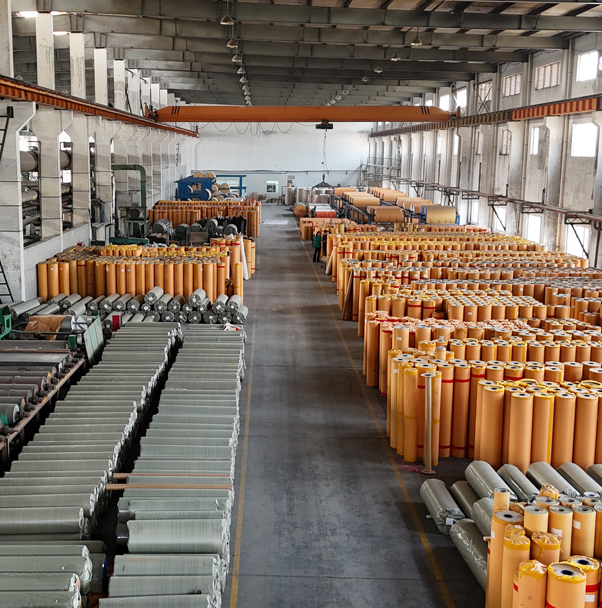
Ready-to-ship roll stock. Farfly holds 300,000 m² of finished inventory, which is what makes a 7-day dispatch model possible for project schedules.
Frequently Asked Questions
Which certifications should a homogeneous vinyl flooring supplier provide for a hospital or school project?
Ask for report numbers that name the product and the thickness. Farfly’s documentation includes SGS report XMIN2109010492CM for EN 14041:2018 together with fire, slip and electrostatic standards; SGS report XMIN2109010493CM for ISO 22196:2011 antibacterial performance; SGS report XMIN2109010491CM for EN 433:1999 residual indentation; and SGS report XMIN2109010490CM for ISO 10581:2019 and related physical properties. On top of these sit a CE certificate TCF-OY20250623-CPR under EN 14041:2018 issued by ICR Co. Ltd. and valid until 25 June 2030, an EU REACH SVHC certificate EQO20030442C covering the 205-substance list, a VOC emission report WT2020B01A03405 issued by CTC, and ISO 9001:2015, ISO 14001:2015 and ISO 45001:2018 certificates issued by AUBURN.
Can a roll floor be customized for a specific project?
Yes, within the limits of the construction. Farfly operates OEM and ODM production with customization of dimensions, color, design pattern, packaging, logo, craftsmanship and structure, supported by six production lines, a monthly capacity of 600,000 m² and an annual output of 4,200,000 m². What cannot be changed is the physics: because the pattern is through-body, the achievable design range is narrower than a printed heterogeneous product, so a highly detailed graphic belongs in a different product family rather than in a homogeneous sheet.
What is the minimum order quantity, and what drives the price?
The minimum order quantity is 100 m², and the delivery terms available are EXW, FCA, FOB, CIF and DDP. Price is driven by product type (standard or ESD), thickness, color, the accessories shipped with the rolls — adhesive and matching welding rod — packaging and the chosen Incoterm. Payment terms are a 50% deposit with the remaining 50% by T/T before shipment, and acceptance is based on a pre-shipment test plus third-party inspection by SGS.
Can we evaluate a sample before committing to a project order?
Sampling is a standard step in Farfly’s project workflow: the Tbilisi hospital package began with product and color selection and physical samples before production. A useful sample request specifies the thickness, the color or pattern reference and the end use, because a 2.0 mm roll for a hospital corridor and a roll for an ESD operating theater are different products. Sample requests and color cards can be raised through the contact details at the end of this page.
How fast can an order be dispatched?
Farfly runs a 7-day rapid dispatch model backed by 300,000 m² of ready-to-ship inventory, and supports mix-container shipping for contractors combining several products or colors in one shipment. Lead time after dispatch depends on destination and Incoterm rather than on production alone, so the shipment plan should be agreed together with the order rather than after it. For tendered project schedules, confirm availability in writing before submission — a sample request or a quotation is the fastest way to start that conversation.
Conclusion: A Floor Is a System, Not a Roll
Homogeneous vinyl flooring earns its place in hospitals and schools for reasons that can be stated plainly: a single-layer construction with color through the full thickness, a continuous sheet with welded and coved edges, a wear classification that matches heavy institutional traffic, and a set of testable claims covering antibacterial performance, emissions, indentation and static behavior. The roll format is what makes the hygiene argument work; the construction is what makes it last.
For a first-time buyer the practical sequence is to define the requirement room by room, ask for certificate numbers that match the product being purchased, and treat installation — substrate, adhesive, welding, coving — as part of the purchase rather than something that happens afterwards.
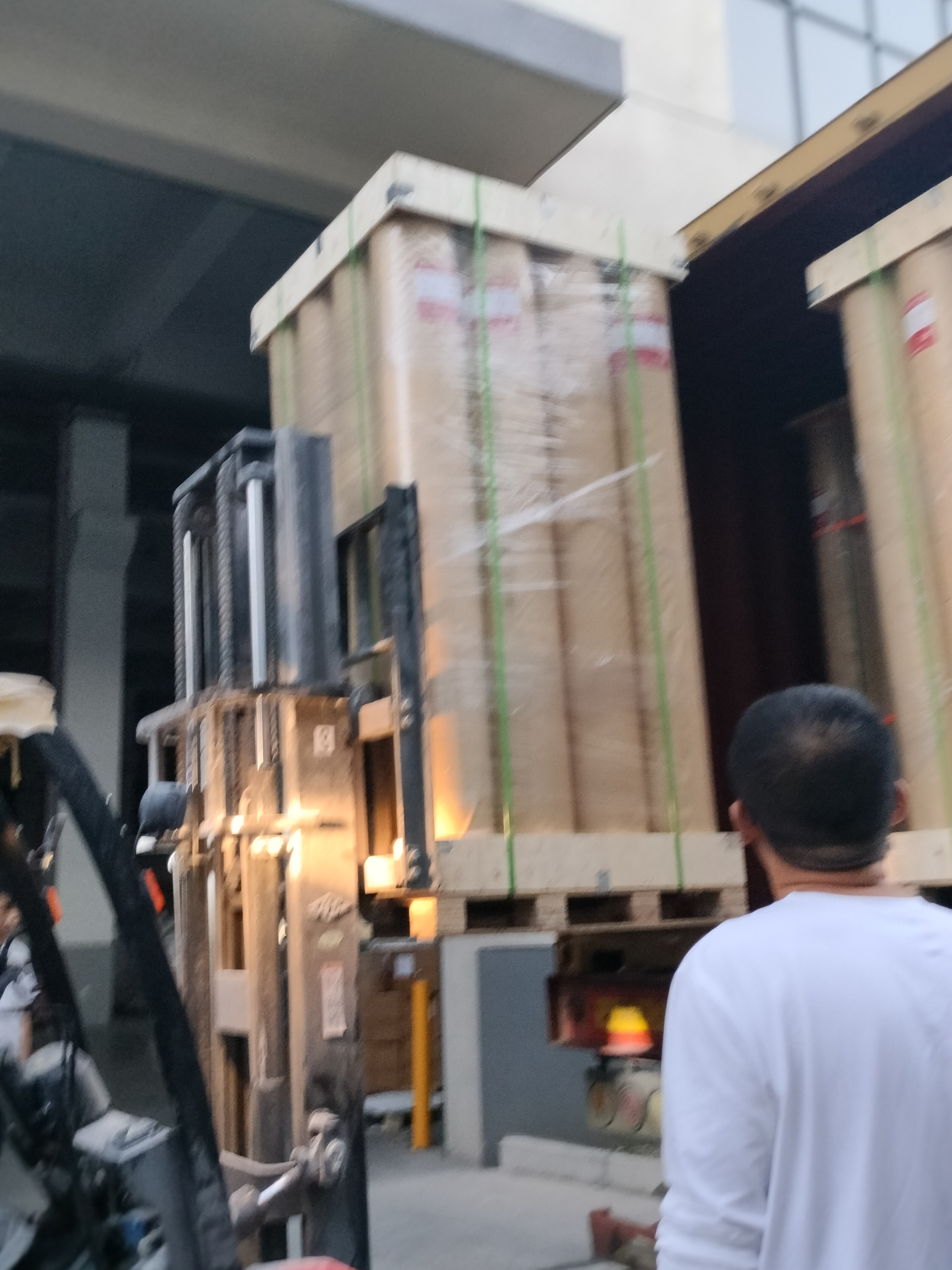
Mix-container dispatch of roll flooring and accessories. Flooring, welding rod and adhesive travelling together is what keeps an installation on schedule.
Next Step: Sample, Quotation or Full Catalog
FARFLYING FLOORING (WUXI TEFA DECORATION MATERIAL CO., LTD.) supplies homogeneous vinyl roll flooring for hospitals, schools, laboratories and commercial projects, with certificates, accessories and installation guidance shipped as one package.
Email: mara@topvcfloor.com · WhatsApp: +86-18751567592 · Website: topvcfloor.com
Address: NO.5 HUAQING INTELLIGENT PARK, HUISHAN DISTRICT, WUXI, JIANGSU, CHINA
Download the full product catalog (PDF): Farfly flooring catalog
Have Questions or Need More Details?
Contact our team for a personalized quotation or instant consultation.
Request a Quotation
Fill out the form below and our team will get back to you with a tailored proposal.
WhatsApp Direct Chat
Prefer to chat in real-time? Message us on WhatsApp for instant assistance & quick answers.
- Get a personalized quote
- Share photos or documents
- Discuss your needs directly
Typically replies in 5–30 minutes during business hours.