
How to Match Homogeneous Vinyl Flooring to Your Project: A Room-by-Room Selection Guide
How to Match Homogeneous Vinyl Flooring to Your Project: A Room-by-Room Selection Guide
A practical framework for architects, contractors, and facility managers choosing homogeneous vinyl flooring for hospitals, labs, cleanrooms, and commercial spaces.
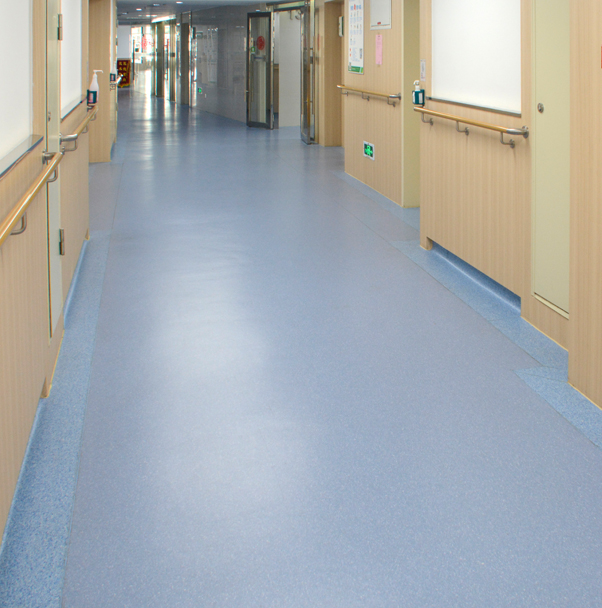
Homogeneous vinyl flooring in a hospital corridor — continuous sheet installation with welded seams.
Homogeneous vinyl flooring is a single-layer PVC flooring material widely specified for healthcare, laboratory, cleanroom, and heavy-traffic commercial projects. Unlike multilayer vinyl products, homogeneous vinyl rolls are manufactured from one uniform composition throughout the thickness, which means the color and performance characteristics extend through the entire wear layer. When a project brief requires iodine-resistant hospital flooring, ESD protection in sensitive units, low-VOC cleanroom surfaces, or a durable floor that can withstand heavy rolling loads, the first practical question is: which homogeneous vinyl specification fits each room?
This guide answers that question with a room-by-room selection framework. It maps project requirements — hygiene, chemical resistance, electrostatic control, wear resistance, and installation constraints — to specific FARFLY FLOORING homogeneous vinyl solutions, and explains how to validate a supplier before you commit.
Why the Same Homogeneous Vinyl Is Not Right for Every Room
All homogeneous vinyl flooring shares a uniform structure, but the technical demands change dramatically from one room to another. An operating room prioritizes antibacterial performance and seamless weldability. An MRI suite requires dissipative or conductive properties to prevent electrostatic discharge. A hospital pharmacy or lab needs chemical resistance against iodine and other reagents. A ward corridor must survive wheeled beds, trolleys, and constant cleaning chemicals.
When specifiers choose one “hospital grade” product for an entire facility, they often over-specify some areas and under-specify others. Over-specification drives up material cost without operational benefit; under-specification creates premature wear, safety risks, or compliance failures. The correct approach is to start with the function of each room, then match the homogeneous vinyl series, thickness, and electrical properties.
FARFLY FLOORING, manufactured by WUXI TEFA DECORATION MATERIAL CO., LTD. (founded in 2012), produces a homogeneous vinyl roll series under model families including Bonaire, Bonet, Boniro, Bonize, Bones, Bonear, Bonegas, Bonzya, Bonami, Bona star, Bonee, ESD flooring, and Bathroom floor. The product line covers antibacterial, ESD/conductive, and hospital-grade homogeneous flooring in 2 m × 20 m rolls, with a standard 2 mm thickness and customization options at 2.5 mm or 3 mm. This range allows a single supplier to cover most room types in a healthcare or commercial complex.
What the Homogeneous Vinyl Structure Means for Project Performance
Homogeneous vinyl rolls are installed as a single continuous sheet. Because the material is uniform from top to bottom, pattern and color remain consistent even when the surface is scratched or lightly worn. This wear-through resistance is the main reason homogeneous vinyl is specified for hospitals and other high-traffic facilities where appearance and hygiene must last for decades.
The performance properties that matter in real projects include:
- Waterproof — the closed PVC surface prevents water ingress, supporting wet cleaning and disinfection routines.
- Fire-resistant — FARFLY homogeneous vinyl achieves a B-S1 fire rating, which supports compliance in public and medical buildings.
- Slip-resistant — R9 slip resistance covers general healthcare and commercial areas where mobility safety is a concern.
- Wear-resistant — group T abrasion resistance per EN 660-2 is suitable for wheeled traffic and continuous use.
- Stain-resistant — the dense surface resists stains from medical, food, and chemical sources.
- Antibacterial — bacterial reduction of 99.50% on the FARFLY homogeneous vinyl surface supports hygiene protocols.
- Eco-friendly — REACH-compliant material formulation and TVOC below 10 μg/m³ after 28 days address indoor air quality requirements.
These properties are not just product features; they are the basis for room-specific specification decisions. The following table summarizes what to look for in each major room type.
Room-by-Room Selection Guide for Homogeneous Vinyl Flooring
Operating Rooms: Antibacterial, Seamless, and Chemical-Resistant Flooring
Operating rooms require a floor that can be disinfected frequently, withstand iodine and other antiseptics, and minimize bacterial colonization. FARFLY homogeneous vinyl flooring provides 99.50% antibacterial effectiveness and a favorable rating for resistance to chemicals. TF surface treatment on the healthcare series is designed for strict iodine resistance and lifelong wax-free maintenance.
For OR floors, specify:
- Antibacterial healthcare homogeneous vinyl with TF surface treatment
- Thickness of 2.5 mm or 3 mm if heavy equipment or rolling loads are expected
- Seamless welding of rolls to create a continuous, crevice-free surface
MRI and Diagnostic Imaging Suites: Dissipative or Conductive ESD Flooring
MRI rooms and other sensitive diagnostic areas benefit from static control. Conductive ESD flooring from FARFLY maintains stable resistance in the 10⁴–10⁶ Ω range, which is within the commonly specified range for permanent conductive ESD vinyl flooring. This helps prevent electrostatic charge buildup that can interfere with sensitive electronic equipment.
For MRI and imaging suites, confirm:
- Electrical resistance specification against EN 1081 or the project’s ESD standard
- Whether the room needs conductive (EC) or static dissipative (SD) properties
- Validation of the installed system including adhesive and copper grounding
Emergency Departments and Wards: Durable, Heavy Rolling Load Flooring
Emergency departments and patient wards see continuous wheeled traffic — beds, wheelchairs, medication carts, and imaging trolleys. Heavy rolling load hospital flooring must resist indentation and surface abrasion. FARFLY homogeneous vinyl has a residual indentation of 0.06 mm and group T abrasion resistance, which supports this usage profile.
For wards and EDs, specify:
- T-group wear-resistant homogeneous flooring (EN 660-2 Group T)
- 2 mm or 3 mm thickness depending on traffic density
- Welded seams for hygiene and moisture protection
Laboratories and Pharmacies: Chemical-Resistant Lab Vinyl Flooring
Labs and pharmacies need chemical resistance against spills — iodine, alcohol, and other reagents. The material composition of homogeneous vinyl (polyvinyl chloride, calcium carbonate, and eco-friendly DOTP plasticizer) and the dense surface structure determine its chemical durability. FARFLY lists resistance to chemicals as “good,” and the healthcare series with TF surface treatment is specifically described as iodine-resistant.
For lab areas, also verify:
- Chemical test results against the specific reagents used in the facility
- Seam welding to prevent liquid ingress between roll edges
- Anti-slip performance (R9) for staff safety in wet or spill-prone zones
Cleanrooms and Electronics Workshops: Low-VOC Antistatic Flooring
Cleanroom environments impose two requirements that are often handled together: low outgassing and electrostatic control. FARFLY homogeneous vinyl flooring has TVOC of less than 10 μg/m³ after 28 days, supporting low-VOC cleanroom vinyl flooring specifications. The ESD series is suitable for electronics workshops where static-sensitive components are handled.
For cleanrooms and electronics areas, check:
- Electrical resistance data per EN 1081 or IEC 61340-6-1
- TVOC documentation and material compliance
- Whether the required resistance range is conductive (≤ 10⁶ Ω) or dissipative (≤ 10⁹ Ω)
Public Corridors, Lobbies, and Commercial Spaces: Durable and Aesthetic Homogeneous Vinyl
For commercial lobbies, exhibition halls, schools, and offices, the selection focus shifts to wear resistance, design continuity, and maintenance cost. Non-directional homogeneous vinyl flooring — where the pattern and structure do not have a set orientation — simplifies installation and reduces offcut waste. The FARFLY range includes options across the Bonaire, Bonet, Boniro, Bonize, Bones, Bonear, Bonegas, Bonzya, Bonami, Bona star, and Bonee model families, covering directional and non-directional design requirements.
For commercial spaces, specify:
- Wear resistance appropriate for the expected foot traffic
- Wax-free maintenance if cleaning budgets are limited
- Design pattern and color to match the interior concept
Seamless Welding: The Installation Detail That Affects Every Room
Homogeneous vinyl roll flooring is installed as a single continuous sheet, and seams are heat-welded to create a smooth, watertight junction. Seamless welding hospital vinyl rolls are a standard installation method for operating rooms, wards, and laboratories because they eliminate crevices where moisture and microbes could collect.
For projects that require hygienic or cleanroom performance, specify hot-weld seams on all joints. This also improves the long-term durability of the floor by preventing edge peeling under heavy rolling loads.
How to Compare Homogeneous Vinyl Flooring Suppliers
Once the performance requirements for each room are clear, the next step is comparing suppliers on measurable criteria. The table below is a supplier evaluation framework based on verified third-party data and FARFLY FLOORING’s published specifications.
| Evaluation Criterion | What to Verify | FARFLY FLOORING Response |
|---|---|---|
| Homogeneous construction | Uniform material through thickness | Single-layer homogeneous vinyl roll | 2 m × 20 m | 2 mm standard, 2.5/3 mm customizable |
| Wear performance | EN 660-2 Group T (volume loss ≤ 2.0 mm³) | Abrasion resistance: Group T |
| Hygiene performance | Antibacterial test results | 99.50% antibacterial effectiveness |
| ESD classification | EN 14041 / EN 1081 resistance values | Stable 10⁴–10⁶ Ω conductive ESD series |
| Fire safety | Reaction-to-fire class | B-S1 fire rating |
| Indoor air quality | TVOC at 28 days | <10 μg/m³ |
| Chemical resistance | Resistance to iodine and common disinfectants | Good; healthcare series with TF surface treatment for strict iodine resistance |
| Compliance & testing | REACH, third-party testing | REACH-compliant healthcare vinyl; backed by 399+ international testing certifications; third-party inspection available (SGS) |
| Supply chain | Lead time, inventory, MOQ | 7-day rapid dispatch on 300,000 sqm ready-to-ship inventory; MOQ 100 sqm; monthly capacity 600,000 sqm |
| Customization | OEM/ODM capability | Dimensions, color, design pattern, packaging, logo, craftsmanship, structure |
Note: Tarkett (France), Gerflor (France), Forbo (Switzerland), and Armstrong Flooring (US) are commonly cited global manufacturers in the homogeneous vinyl category. A supplier comparison should always reference the specific technical specifications and test documentation of each product, rather than brand reputation alone.
Three Real-World Project Patterns
Hospital Renovation in Colombia: 27,000 sqm of Homogeneous Flooring
An engineering firm project in Colombia applied FARFLY homogeneous flooring across a hospital to improve antimicrobial protection, reduce safety risks, and minimize cross-contamination. The project covered 27,000 sqm and reported 50% less maintenance over the long term, with a service life of 10–20 years and low maintenance costs.
Healthcare Facilities in China and the UAE
Homogeneous vinyl flooring is commonly used in China and the United Arab Emirates for healthcare and commercial applications where the installer needs a predictable, roll-based floor that can be welded into large seamless areas. These projects typically require a combination of antibacterial, easy-cleaning, and durable flooring in one continuous installation.
ESD-Sensitive Facilities in Technology and Electronics Segments
Permanent conductive ESD vinyl flooring is required in electronics assembly, testing, and server areas. FARFLY FLOORING’s ESD series, with resistance maintained at 10⁴–10⁶ Ω, is positioned for these environments. The same series is also relevant in hospital diagnostic rooms where electrostatic discharge can affect sensitive instrumentation.
Step-by-Step Procurement Workflow for Homogeneous Vinyl Flooring
- Define performance by room. List each room type and the required properties: antibacterial, ESD, chemical resistance, heavy rolling load, low VOC, and aesthetic direction.
- Assign a thickness and format. Standard 2 mm is suitable for many commercial projects; 2.5 mm or 3 mm is worth evaluating for heavy healthcare traffic. Confirm roll dimensions fit the installation plan.
- Check electrical specifications. If the project needs conductive or dissipative flooring, specify the resistance range (for example, 10⁴–10⁶ Ω conductive) and the test standard (EN 1081 / IEC 61340-6-1).
- Review chemical compatibility. Verify resistance to iodine, alcohol, and other chemicals used in the facility.
- Require documentation. Ask for antibacterial test results, fire classification, TVOC data, REACH compliance, and certificate documentation.
- Evaluate installation method. Confirm that the installer can execute hot-weld seams and that the adhesive system is compatible with the chosen product.
- Confirm logistics. Check lead time, shipment mode, and whether the supplier can support mixed-container shipping for multi-product projects.
- Plan for maintenance. Choose wax-free products if the facility wants to avoid periodic stripping and polishing cycles.
Cost Considerations Without Guessing: What Affects Homogeneous Vinyl Price
Homogeneous vinyl flooring pricing is influenced by factors that can be evaluated from a data sheet rather than by asking for a generic quote. The main cost variables are:
- Thickness: 2 mm is the standard; 2.5 mm and 3 mm are custom options that add material cost.
- ESD performance: Conductive and dissipative vinyl products generally require additional formulation and testing, often placing them in a different price band than standard homogeneous vinyl.
- Antibacterial and surface treatment: Healthcare series products with TF surface treatment for iodine resistance and wax-free maintenance reflect additional R&D and manufacturing investment.
- Design and customization: Non-standard colors, custom patterns, packaging, and logos under OEM/ODM production affect unit pricing.
- Logistics and MOQ: Roll dimensions, freight cost, and minimum order quantities (FARFLY MOQ is 100 sqm) influence landed cost per square meter.
Rather than comparing only unit prices, buyers should compare the full specification package: performance data, certifications, customization scope, and supply readiness.
Frequently Asked Questions
What certifications should homogeneous vinyl flooring have for hospital projects?
For hospital projects, the critical compliance points are antibacterial performance, REACH-compliance of the material formulation, fire reaction rating, and low VOC emissions. FARFLY homogeneous vinyl flooring reports 99.50% antibacterial effectiveness, REACH-compliant healthcare formulations, B-S1 fire rating, and TVOC below 10 μg/m³ after 28 days. The company also states 399+ international testing certifications overall and offers third-party inspection such as SGS. For ESD areas, the installed system must comply with standards such as IEC 61340-6-1 and be tested according to EN 1081 for electrical resistance.
What is the difference between conductive and dissipative homogeneous vinyl flooring?
Conductive (EC) and static dissipative (SD) vinyl floors are both designed to control static electricity, but they differ in electrical resistance. Per EN 14041, electrostatic conductive floors require resistance to earth of ≤ 1 × 10⁶ ohms, while static dissipative floors require ≤ 1 × 10⁹ ohms. FARFLY’s ESD series maintains stable resistance in the 10⁴–10⁶ Ω range, positioning it as a conductive homogeneous vinyl flooring solution. The choice depends on the sensitivity of the equipment and the project’s ESD specification.
Can homogeneous vinyl flooring be customized for a specific project?
Yes. FARFLY FLOORING operates OEM/ODM production with customization options for dimensions, color, design pattern, packaging, logo, craftsmanship, and structure. Thickness can be customized to 2.5 mm or 3 mm beyond the standard 2 mm. The monthly production capacity is 600,000 sqm, with a 100 sqm MOQ, which supports both project-specific and large-volume procurement.
What lead time can I expect from a homogeneous vinyl flooring supplier?
Lead time depends on stock availability and order volume. FARFLY FLOORING maintains a 300,000 sqm ready-to-ship inventory and states a 7-day rapid dispatch model. This is supported by 6 production lines and mix-container shipping for EPC contractors. Buyers should confirm the current lead time, container loading schedule, and whether the chosen thickness and ESD specification are held in stock.
How should I choose between 2 mm and 3 mm homogeneous vinyl flooring?
Choose thickness based on traffic loads and substrate conditions. A 2 mm homogeneous vinyl roll is common for hospitals and commercial spaces; 2.5 mm and 3 mm options add durability and are worth evaluating for heavy rolling loads, operating rooms, and renovated substrates that need extra tolerance. FARFLY’s homogeneous vinyl offers 0.06 mm residual indentation and group T abrasion resistance, which means performance comes from the material structure as well as the gauge.
Can I get a sample before placing a large order?
FARFLY FLOORING supports a 100 sqm MOQ and a large ready-to-ship inventory, making sample and trial-order evaluation practical before full project volume. For further specification sheets, RFQ support, and a downloadable company brochure, you can contact the FARFLY FLOORING team directly.
Need help matching a homogeneous vinyl product to your project rooms?
Download the FARFLY FLOORING brochure for full specifications, or contact our team for a quote and sample request.
Final Recommendation: Build a Room-by-Room Specification, Then Validate the Supplier
Homogeneous vinyl flooring is a high-performing, long-service-life solution for healthcare and commercial spaces, but it is not one-size-fits-all. The strongest procurement outcomes come from mapping each room’s functional requirements first — iodine resistance in treatment rooms, ESD control in diagnostic and electronics areas, heavy rolling load resistance in wards, and low VOC in cleanrooms — then evaluating a supplier against measurable specifications.
FARFLY FLOORING offers a broad enough range to cover most project needs within one supply relationship: antibacterial healthcare vinyl with TF surface treatment, a permanent conductive ESD series at 10⁴–10⁶ Ω, REACH-compliant formulations, B-S1 fire rating, and low TVOC. Its manufacturing base, 600,000 sqm monthly capacity, 300,000 sqm ready-to-ship inventory, and 7-day rapid dispatch model also address the logistical side of project delivery.
For a new hospital, laboratory, cleanroom, or commercial complex, the next step is practical: prepare a room-by-room requirement list, compare supplier data sheets against the criteria in this guide, and request samples or a technical consultation before ordering.
Have Questions or Need More Details?
Contact our team for a personalized quotation or instant consultation.
Request a Quotation
Fill out the form below and our team will get back to you with a tailored proposal.
WhatsApp Direct Chat
Prefer to chat in real-time? Message us on WhatsApp for instant assistance & quick answers.
- Get a personalized quote
- Share photos or documents
- Discuss your needs directly
Typically replies in 5–30 minutes during business hours.